Hello, well the Brits just gave the nasty party free reign to bleed the little people dry, it will end in tears and quiet possibly lead to the formal break up of Great Brittain as the Scots will have none of that Tory party shite. It's that archaic first passed the post voting system and something called safe seats that makes UK politics a sad joke. But hey those silly Brits are told by the bully boys to be proud of their ideocies, ah yes those easily cowed islanders...
The history of rhythm and blues is filled with vocal groups whose names -- the Orioles, the Cadillacs, the Crows, the Flamingos, the Moonglows, the Coasters, the Penguins -- are held in reverence by fanatics and devotees. The Drifters are part of an even more exclusive fraternity, as a group that managed to carve out a place for themselves in the R&B firmament and also define that music, not only at its inception as a national chart phenomenon in the early '50s but also in the decade that followed. Their place in history is as complex as their role in it, by virtue of the fact that there are two distinct phases to their music and the continuity of their membership, and their extraordinary longevity -- only the Platters could claim as great a span of years as an active recording unit, though the latter group, due to major differences in the way they were organized, were far more stable in their membership and output. The Drifters can also claim a unique place in popular music history, as a major R&B group founded at the instigation of a record-label chief. N'joy
xxxxx xxxxx xxxxx xxxxx xxxxx
The Drifters story began in early 1953, when Clyde McPhatter, the soaring high-tenor lead singer in the Dominoes, a vocal quintet formed by Billy Ward three years earlier, quit that group. the Dominoes were playing a scheduled gig at the New York club Birdland, one of their first performances without McPhatter, when one of the audience members present asked after the singer backstage. That fan was Ahmet Ertegun, a one-time record collector who had started Atlantic Records in the late '40s; as soon as he learned of McPhatter's having left the Dominoes, he contacted the singer and signed him to Atlantic.
It was Ertegun who gave McPhatter the impetus, as part of his contract, to start a group of his own, which came to be called The Drifters. The origins of the name and credit for thinking of it are obscure, although no one at Atlantic liked "The Drifters" at first, thinking it sounded too country & western -- the explanation sometimes offered by those present was that the members simply drifted in from other groups.
The main source for McPhatter's backing singers was among the ranks of former members of the Mount Lebanon Singers, the gospel group with which McPhatter had sung in the '40s. He went through several attempts at assembling a group that would be acceptable to Ertegun and producer Jerry Wexler, going through as many as a dozen friends and acquaintances, a handful of whom actually made it to formal recording sessions. The initial, unsuccessful lineup, featuring William Anderson, David Baughn, Dave Baldwin (the brother of author James Baldwin), and James Johnson, recorded four songs on June 28, 1953, of which only "Lucille," a McPhatter-authored song, was ever released. In August, a second Drifters lineup was put together, with Gerhart Thrasher, Andrew Thrasher, two very experienced gospel singers on tenor and baritone, respectively, bass singer Willie Ferbee, and Walter Adams on the guitar. From the beginning, the group was unusual among R&B vocal ensembles in that a guitarist was part of their core lineup and the electric guitar central to their arrangements; Jimmy Oliver, who would soon take that spot as his own, also proved to be an important songwriter for The Drifters, especially for tenor Gerhart Thrasher. The new edition of the group cut five numbers on August 9, 1953, one of which was "Money Honey," written by arranger/pianist Jesse Stone. Released within a few weeks, it hit the number one spot on the R&B chart by mid-fall of that year, and it was occasionally cited in later years as the first rock & roll record, and later entered the repertory of Elvis Presley and dozens of lesser talents. The group's career was made after that, at least as long as Clyde McPhatter was singing lead with them.
This success didn't stop the regular lineup changes that would characterize The Drifters' history. By the time The Drifters were enjoying their breakthrough hit, a reconstituted lineup, with bass singer Bill Pinkney and guitarist Jimmy Oliver joining Gerhart Thrasher and Andrew Thrasher, cut their first session. This was the lineup that lasted for the year that followed, and cut "Such a Night," a number two R&B hit, and a second R&B chart-topper with "Honey Love" in early 1954. By that time, the charts and radio play, along with audience sensibilities, had opened up and "Honey Love" also made number 21 on the pop charts late that spring. Not for the last time, it seemed as though The Drifters were headed for big things together, but a key member had developed other ideas by the fall of 1954.
Although he'd been assured of a considerable amount of musical control, McPhatter found that Ertegun and Wexler were, as the producers, always trying to push the group into directions of their own choosing. McPhatter didn't begrudge them their efforts at finding new sounds that might sell records to white as well as black audiences, but he didn't feel like participating. His goal was to cross over to pop audiences as a balladeer, and saw himself as having the potential to become another Nat "King" Cole, or perhaps a black answer to Frank Sinatra or Perry Como. By October of 1954, he had parted company with the group in favor of a solo career that would make him a success for the rest of the 1950s.
Rather than see the group in which they'd invested 18 months of their time go out of existence, Ertegun and Wexler were still interested in recording The Drifters, but that group's internal circumstances were vastly different once McPhatter was gone. He had organized The Drifters under the auspices of his own business entity, Drifters Incorporated, so that he would have a share of their earnings, something that he'd been denied in the Dominoes; his own willingness to share those earnings with the other members has never been broached or questioned. He was half-owner of the group with his manager, George Treadwell, a former jazz musician who had masterminded the solo career of his first wife, Sarah Vaughan; when McPhatter left the group, rather than making a provision for the other members and his eventual successor to get his share, he sold out his interest in Drifters Incorporated to Treadwell.
This basically doomed the group to a permanent revolving-door lineup. From that day forward, all of the members of The Drifters were salaried employees, earning as little as $100 a week even into the early '60s, and getting no share of royalties from record sales, no benefits from the concert fees they commanded, nor any claim to the use of the name "The Drifters" if they left, no matter how successful the group became through their efforts. It thus became impossible for the group to hold on to anyone with serious talent or aspirations for a long-term career in music. This made The Drifters, for those present after McPhatter's exit, little more inviting than McPhatter's own tenure with the Dominoes, and he later regretted making the decision, recognizing not only what he had cheated himself of out by not hanging on to his share of the ownership but also what he had done to his fellow musicians.
The immediate problem facing all concerned in 1954, however, was finding a replacement for Clyde McPhatter, and some would argue that they never did. David Baughn, who had sung with a very early version of The Drifters, came in as a temporary replacement, singing at one recording session and serving as lead vocalist for six months' worth of live engagements (which was how the group generated most of its income). Baughn's singing was good enough, but the group sounded like an imitation of the McPhatter-era Drifters, and Atlantic declined to release any of these sides at the time, possibly due to their potential to interfere with McPhatter's solo releases, which were selling well. The label didn't know whether to shoot for an entirely new sound or to try to find a replacement who sounded like the former lead singer who, by 1956, was a major R&B star in his own right. Additionally, Baughn soon demonstrated an erratic personality, sufficiently unnerving to force Treadwell to recruit a second lead vocalist in Bobby Hendricks, who had previously sung with the Five Crowns and the Swallows. Attempts were made to record this lineup, and even bass singer Bill Pinkney was cut doing a lead vocal, but none of it was considered acceptable.
The lineup itself began to shift as Baughn quit, but the group soldiered on, drawing good crowds at their shows based on the quality of their earlier recordings. In 1955, however, they auditioned a young man who approached the group after a show in Cleveland. Johnny Moore had been a member of a group called the ornets, who had done a little bit of recording without making any more than a local reputation for themselves. He sounded enough like McPhatter, however, with his pleasing high tenor, and was offered a spot in The Drifters the next day. Moore would prove to be a mainstay of the group in two different decades.
The Drifters resumed recording in September of 1955, with Nesuhi Ertegun and songwriter Jerry Leiber producing and with Moore singing lead. The result was a number one R&B chart single, "Adorable," which went a long way toward establishing their post-Clyde McPhatter reputation. This proved to be one of the very few major chart records they would enjoy during this era, however -- The Drifters were still absent from the top of the pop charts, where the real money and huge sales figures lay. Their records during the late '50s were overlooked by most young white listeners, despite the presence of future rock & roll standards such as "Ruby Baby" in their output.
Dion would enjoy a much bigger hit with the latter song in the early '60s, but it was an important recording for The Drifters, marking their introduction to the talents of songwriters Jerry Leiber and Mike Stoller, who would later take over the job of producing the group. The Drifters' lineup was also stabilized for the first time in over a year. The original Drifters now entered their "silver age" behind Moore's cool high tenor, ably supported by the bass singing (and occasional lead spot) from Bill Pinkney and Bobby Hendricks' tenor. "I Gotta Get Myself a Woman," written by Jesse Stone and cut during the summer of 1956, brought the group a number 11 R&B hit and the group's fortunes once again seemed to be on a consistent upswing.
As it turned out, the black record-buying public wasn't prepared to fully accept a new Drifters, without McPhatter -- black audiences practically worshipped the singer, who commanded a passionate loyalty that anticipated the future success of Sam Cooke. Additionally, the music was changing -- white teenagers were now a much bigger part of the market than they had been in 1953-54, and Atlantic set its sights on that potentially much richer vein of listeners.
The end of 1956 saw the release of the first album by group, entitled Clyde McPhatter & the Drifters. Such was the popularity of McPhatter at the time, and the tracks that he'd done with The Drifters, versus their recent work, that those 14 songs rated inclusion on an LP well over a year after his exit from the lineup in an effort to sell the music once more to his fans -- in that regard, Atlantic was very forward-looking; very few labels in 1956 were releasing LPs aimed at black R&B listeners (apart from Elvis Presley's albums, very little white rock & roll made an impression on the album charts).
Late 1956 was also the point when the consequences of The Drifters' business organization caught up with the group. Their recent hits had led to more bookings than at any time since 1954, which was good for Treadwell and his partners, but difficult for the members, who were still working on straight salary and, by Bill Pinkney's estimation, very low salaries. He approached Treadwell for a new arrangement, or at least more money for the group members, and he was fired. His dismissal drove fellow founding member Andrew Thrasher out of the lineup as well, and out of music altogether. Pinkney and ex-Drifter Bobby Hendricks became the core of a new Atlantic group called the Flyers, who released one single that failed to attract much attention.
The new Drifters lineup was filled by bass singer Jimmy Ricks and then, more permanently, by Tom Evans, late of the Dominoes, and baritone Charlie Hughes. The group's fortunes now took a new turn as Jerry Leiber and Mike Stoller began producing their sessions in late 1956 -- unfortunately, their arrival on the scene coincided with Johnny Moore's receiving his draft notice in early 1957. The group was (no joke intended) adrift once again, in terms of its sound and lineup. Bobby Hendricks was brought back in, and Jimmy Millender took over the baritone chores, but there wasn't a lot of good material that came from those sessions. For a time, in the absence of an ability to create a successful Drifters sound, it seemed as though Atlantic was trying to turn them into another version of the Coasters, doing light-hearted versions of pop standards. In a way, this was understandable -- black listeners held this era's Drifters at arm's length, while white teenagers were dominating the pop charts and they seemed, at least potentially, open to new records by anyone, so Atlantic decided to cater to them, hoping for a breakthrough.
By late 1958, Hendricks had announced his exit, and even guitarist Jimmy Oliver, who had managed to get several of his songs recorded during his four-year tenure with the group and was an unheralded mainstay of their sound, finally quit. The remaining members, such as they were, were working as hard as ever and wanted more money and, when Treadwell refused their request, they all walked out (or were fired en masse).
Treadwell was about to find himself without a group and faced with upcoming engagements to fulfill at the Apollo Theater in New York. He spotted his way out of this impasse at the Apollo, way down on a bill on May 30, 1958 on which the about-to-be-fired Drifters were headlining. the Five Crowns, or the Crowns, as they were then known, had been a fixture in Harlem for most of the 1950s, predating The Drifters without ever making a mark as a recording act, and enjoying precious little reputation as performers.
Treadwell approached their manager, Lover Patterson, explaining that he was dumping the existing Drifters and needed a new group to fulfill their performing obligations. Patterson agreed and the group followed suit, and all of the individual members' contracts, except for that of one of the group's two baritones, were sold to Treadwell. In later years, this kind of arrangement would become a little more familiar in the business -- the Grass Roots essentially evolved this way, as did the performing version of the group Steam -- but it was unusual in those days, and difficult to pull off, and mostly served to keep Treadwell from ending up in court.
The new Drifters lineup consisted of Charlie Thomas on lead, baritone Benjamin Earl Nelson, later known as Ben E. King, Dock Green (who had held the Crowns together) (baritone), and Elsbeary Hobbs singing bass. They did as they were required under the agreement and, for ten months, worked in the shadow of the old group, playing live gigs characterized by the awkwardness of performing the old songs as though they were their own, to mostly black audiences who knew that these weren't The Drifters. Atlantic still hoped to profit from the group, however, and a second Drifters LP, Rockin' & Driftin', was released in late 1958, comprised entirely of single tracks recorded by the 1955-58 lineup. Ironically, in all of their 19-year history with Atlantic Records, The Drifters, in any incarnation, never recorded an actual "album" session; every one of their LPs was compiled from existing single tracks and B-sides and, except for the first album, all have a mix-and-match element to the memberships and, especially, the singers represented.
The group still had a recording contract with Atlantic Records and, despite the fact that the old Drifters' recent releases had done little business, the label decided to try once more with the new lineup and get a record out. On March 6, 1959, they went into the studio with Leiber & Stoller producing, to cut four songs. Charlie Thomas was supposed to sing lead but he developed mic-fright in the studio, and so Nelson was deputized for "There Goes My Baby," which he had co-written, along with "Hey Senorita," and "Oh My Love." "There Goes My Baby," co-written by Nelson and orchestrated by Stan Applebaum, was as much a landmark in the history of R&B and soul as "Money Honey" had been six years earlier. At the time, nobody present was sure of what they had because it sounded so chaotic, strange, and complicated -- no one had ever used a string section, much less one recorded as prominently as this one was, on an R&B record, and no R&B record up until that time had ever dared sound so complex, overlaying Latin percussion, violins, and a fiercely passionate performance by the singer. It not only didn't sound anything like the old Drifters, but it didn't sound like anything else that had ever been heard on a commercial recording before. And it was a complete mess in the eyes of some observers, including Jerry Wexler, who said the song sounded like a radio picking up two different stations at once.
"There Goes My Baby" peaked at number two, their biggest hit to that date on the pop charts and their biggest seller up to that time, winning over both R&B and pop audiences and transforming the group and its image. Moreover, it marked the group's first impact on audiences overseas -- the earlier Drifters, for all of their impact on rock & roll, never got a record released in Europe, but this new group and their sound would soon find a very important mass audience in England. The group seemed headed for a huge future when the problem of their business set-up came into play again. They'd cut other songs at that same session, including "Baltimore," which sounded like an update of the Cadillacs' "Speedo," but the strings-percussion-echo timbres of "There Goes My Baby," hung around long melodic lines, became The Drifters' trademark sound for the ten years that followed.
This seemed to be a new lease on life to the group, and then more troubles arose from within, owing to the way The Drifters were organized as a business. Ben Nelson wasn't happy working for $100 a week; not with the hundreds of miles of travel between some shows, and as many as six days of shows each week. He was so poor working for the group that he felt compelled to sell off his share of the songwriting on "There Goes My Baby," Accounts differ as to precisely what happened on this issue -- some say that he sold the share off to Treadwell and his accountant, while Jerry Wexler claims that he accepted a document from the singer assigning him the copyright, in exchange for $200; Wexler held on to the document, and gave it back to the singer once the song was a hit so he could tear it up.
After approaching Treadwell for more money and being turned down, Nelson saw that there was no future as a member of The Drifters and announced his exit almost as soon as it came time to cut a follow-up. At the same moment, Lover Patterson played his trump card, a separate contract that he'd signed with the singer, as a solo artist, dated before Treadwell's offer. It all could have ended up in court but luckily for the singer and fans of The Drifters, cooler heads prevailed. He remained with Atlantic Records on their Atco subsidiary as a solo artist, and agreed to record with the group until a suitable replacement could be found, singing on "Dance With Me," "This Magic Moment," "I Count the Tears," and "Save the Last Dance for Me," the latter their only number one hit, among other songs, through the spring of 1960. By the time his exit had been arranged, Nelson had changed his name to the more memorable Ben E. King, which was how he emerged in his own right.
The post-1959 Drifters (which also included guitarist Billy Davis) are usually thought of as the "Ben E. King Drifters," but the reality was that King had left the group by the end of that same year. King's first successor was Johnny Williams, who exited suddenly in late 1960, but The Drifters quickly found a replacement in Rudy Lewis. An ex-member of the Clara Ward Singers, Lewis was the singer on "Some Kind of Wonderful," "Up on the Roof" (a Top Five hit), "Please Stay," "What to Do," and "On Broadway" (a Top Ten hit), among numerous other classic tracks by the group. Lewis, tragically, wasn't the longest lasting of the group's lead vocalists but his tenure with the group, following King's, arguably constituted the second half of a second golden age in their history.
Whoever was involved on a particular record, this lineup of the group was once again at a peak of influence in those years. "There Goes My Baby" anticipated the shift to a more pop-oriented brand of soul music, embraced by Sam Cooke and, even more so, by Berry Gordy at his fledgling Motown label. Indeed, the sound of "There Goes My Baby" was practically the prototype for Smokey Robinson & the Miracles' landmark single "Way Over There." Others also learned from them, most notably a young producer named Phil Spector, who was working at Atlantic as a session guitarist in the early '60s and ran with the sound he heard in Stan Applebaum's arrangements, expanding it into something new and turning it into his own trademark, imprinted on the work of a dozen top recording acts. And it was during the recording of his own "Please Stay" by the group that Burt Bacharach first encountered a vocalist named Dionne Warwick, who was part of the backing trio for The Drifters.
Between 1960 and 1964, The Drifters achieved a level of stability that was unprecedented in their history, and it was matched by their success. Not that they didn't make mistakes -- they turned down "This Diamond Ring," and Atlantic never released their version of "Only in America," both of which became huge hits, in the hands of Gary Lewis & the Playboys and Jay & the Americans, respectively. Still, luck was with them even as essential personnel around them moved on -- in late 1963, as Leiber & Stoller shifted their attention to their own record label, Red Bird, The Drifters got a new producer in Bert Berns, a songwriter with a feel for commercial soul music. "Vaya Con Dios," from their first session with the new producer (and which reflected his love of Latin themes), was a moderate pop chart hit. And in the spring of 1964, with Leiber & Stoller no longer writing the way they had been, the group was offered a new song by composers Art Resnick and Kenny Young, called "Under the Boardwalk."
It was scheduled for recording on May 21 of 1964. Then, on the night of May 20, just hours before the recording session, Rudy Lewis was found dead in his apartment under circumstances that are still in dispute -- the police suspected a drug overdose, but people who knew Lewis insisted that his only vice was binge-eating, and that he had choked to death. Without any time to reschedule the session, Johnny Moore, who had rejoined the group as second tenor in early 1963, stepped into the breach. Moore, who had previously held the thankless task of leading the late-'50s Drifters, achieved a special magnificence at that session singing "Under the Boardwalk," which became the group's last Top Ten hit in 1964, peaking at number four. He became the longest lasting of The Drifters' various lead singers, lasting into the 1970s and beyond their time as a serious recording act.
By late 1964, Berns was moving on to other projects including the early releases of his new independent label, Bang Records, and the group found itself working with producer Tom Dowd in what were very unproductive sessions. They still had lots of bookings, and enough hits behind them to remain a thoroughly established act, but by that time the whole notion of soul music was changing around them, due in some measure to a vast array of other acts associated with Atlantic Records, including Wilson Pickett, Otis Redding, Sam & Dave, and Don Covay. The Drifters were never able to make the jump comfortably to this harder brand of soul music, and the loss of Berns as a producer after 1965 seemed to seal their fate. Their own sessions began to show a lack of urgency and organization, exemplified by the fact that one of the very best tracks of Moore's era, "In the Park," was left unfinished (without the group recorded behind him) and in the can for years. The death of George Treadwell in 1967 removed another layer of impetus behind The Drifters' continuation as a going concern.
They continued recording for Atlantic with a succession of producers until 1972. By that time, the company itself was part of a huge corporate conglomerate, far removed from its origins -- Led Zeppelin, Yes, and Emerson, Lake & Palmer were the stars of the Atlantic roster then, and scarcely anyone at the company except Ertegun and Wexler likely even remembered who The Drifters were or how they'd started. Johnny Moore still sang lead, but there were no more hits after the mid-'60s. They tried altering their sound to mainstream adult pop, cutting old-style standards in an effort to capture older listeners. As the hits faded away and the bookings dried up, the group broke up yet again -- in the end, Johnny Moore was the only recognizable Drifter and he did most of the singing on the records as well.
The 1970s saw a proliferation of acts trading on the Drifters name as the rock & roll revival suddenly made the group's classic repertory profitable again. Founding member Bill Pinkney led a group sometimes called "the Original Drifters" while Charlie Thomas led another version and Johnny Moore kept the fully authorized group under the auspices of Treadwell's widow Faye.
The result was a series of lawsuits that ultimately saw the various claimants divide different territories within the United States between them, while the Faye Treadwell-authorized group, led by Johnny Moore, moved to England, where they enjoyed a Top Ten hit in 1972 ("Come on Over to My Place"), falling under the influence of the Roger Cook/Roger Greenaway songwriting team. This incarnation of the group, no longer signed to Atlantic after 1972, was signed to Bell Records. The British-based version of The Drifters became a dance-disco outfit for a time in the late '70s, virtually irrelevant to the group's history, while Pinkney and Thomas maintained contact with The Drifters' roots, and even Jimmy Ricks, who was only in the group for a few months, turned up at some point leading a combo using the name. Ben E. King even returned to the lineup for a tour in the late '80s.
In the 1990s, after decades of conflicting and contradictory claims, a new court ruling determined that Faye Treadwell owned the trademark of The Drifters' name. The death of Johnny Moore in the 1990s brought the end of the era in the group's history, though Bill Pinkney -- the last active original member from the early '50s -- continued to front a group of Drifters up until his death on July 4th, 2007. The late '80s and early '90s also saw a full revival of the group's entire catalog; for decades, from the 1960s through the 1980s, fans and collectors in America had to content themselves with a single LP, the 1968 Golden Hits album, consisting of a selection of the group's early-'60s hits -- none of the McPhatter-era cuts were around, nor were any other tracks from the '60s era. A pair of Rhino Records-inspired double-CD/LP sets helped break this log-jam in the late '80s, and Rhino's 1996 triple-CD set Rockin' & Driftin': The Drifters Box opened the floodgates of their history. That same year, Sequel Records in England issued seven CDs devoted to the group's history, and more recently Collectables Records has been busy re-releasing the group's classic albums on CD.
xxxxx xxxxx xxxxx xxxxx xxxxx
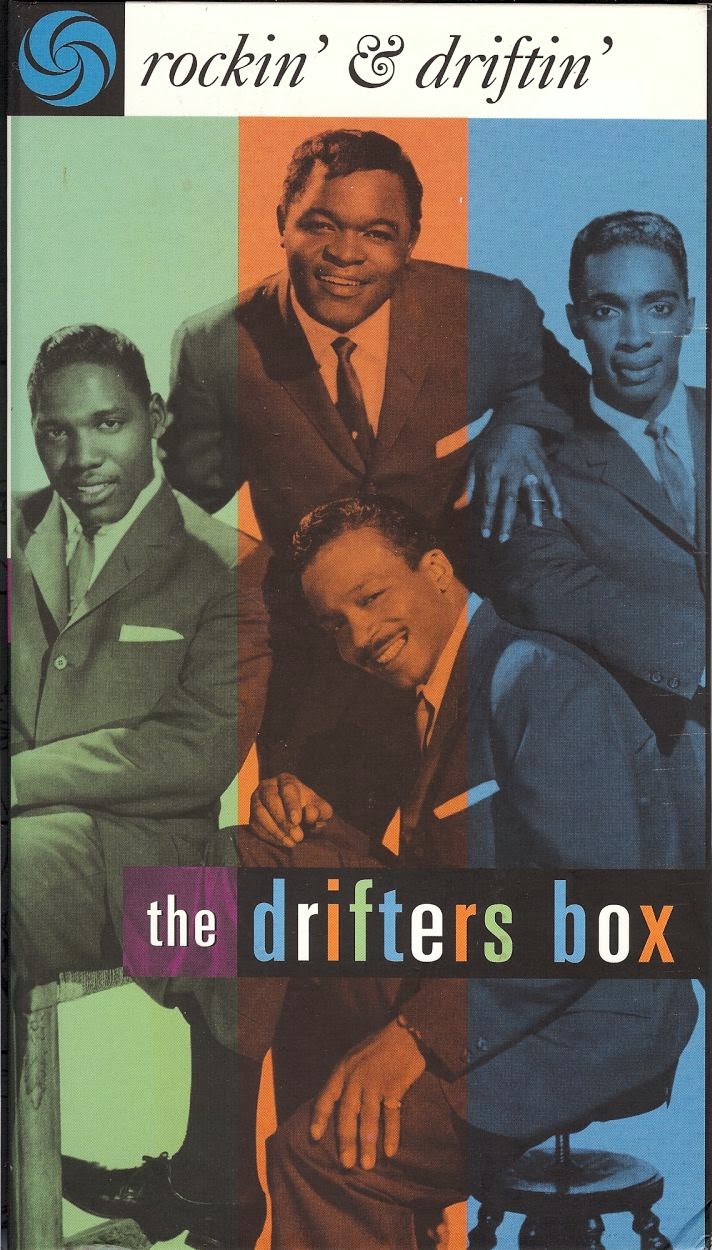
This triple-disc 79-song compilation looks pretty impressive, and in some ways it is, representing most of the best work of each incarnation of the Drifters from 1953 through 1976. There's a lot of classic music here, including all of the big hits and many interesting (even musically glorious) flops and B-sides, but the limitations of three CDs make this less than ideal. Atlantic had already released a pair of two-CD sets, Let the Boogie Woogie Roll: Greatest Hits 1953-58 and All-Time Greatest Hits & More: 1959-1965, eight years earlier, each of which covers those major periods in question far more generously than does this box -- although it must be conceded that the sound on the cuts included on Rockin' & Driftin' is improved over those late-'80s digital transfers, good as they seemed at the time. Additionally, almost concurrent with this release from Rhino Records in America, Sequel Records in England issued its Drifters Anthology series, assembling the group's complete Atlantic Records output on seven separate CDs, organized somewhat awkwardly at times but also including a number of outtakes, so serious fans may want to opt for that group of discs. This set, had it gone to four CDs, could have been truly comprehensive, covering all of those bases by grabbing some of the best of those genuinely beautiful outtakes, such as "In the Park" -- as it is, the only unreleased cut here is the group's version of "Only in America" -- and oddities like the achingly soulful "She Never Talked to Me That Way," plus all of the official live recordings that they left behind from the mid-'60s. At three CDs, it's a little squeezed, especially as the producers devote some space and attention on concurrent solo hits by Clyde McPhatter and Ben E. King. As it is, this set covers the group's history into their 1970s era work on Bell Records and Arista Records, which did yield some serious hits in the U.K. (where the Johnny Moore-version of the group relocated in the early '70s) and which don't sound bad; they're but a shadow of the group's classic early-'60s singles, but songs like "Kissin' in the Back Row of the Movies" and "Down on the Beach Tonight" are perfectly listenable. Those tracks are not necessarily worth the 40-50 dollars that this set costs, but coupled with the gorgeous sound of the classic material and the almost book-length essays that accompany the set, this is a purchase to consider, especially for anyone who doesn't already own the earlier Atlantic double sets or the Sequel collection. Anyone who has the Sequel discs may well want to pass this up, but for anybody building a Drifters collection beyond the '60s hits, this will supply most of what's needed, and serve as a guide of where to go for a closer listen to specific parts of their history. The essays are highly detailed, covering several different angles on the history of the group, and are refreshingly, highly opinionated (although some fans may pause over the slights given to Johnny Moore as the group's last lead singer -- no, he wasn't Clyde McPhatter or Ben E. King, or even Rudy Lewis, but he did sing beautifully). As a significant bonus, along with the previously unreleased 1963 version of "Only in America," a song which was subsequently placed with Jay & the Americans (who had a hit with it) because it was deemed too upbeat (despite the obvious irony that was intended) for a black group to release, one gets a very full account of the contortions that the composers, producers, and Atlantic went through over the song. Comes with an extensive booklet

The Drifters - Rockin' & Driftin' 01 (flac 296mb)
01 Let the Boogie Woogie Roll 2:50
02 Money Honey 2:58
03 Lucille 3:04
04 The Way I Feel 2:46
05 Such a Night 2:30
06 Gone 2:41
07 Don't Dog Me 2:33
08 Bip Bam 2:47
09 The Bells of St. Mary's 2:41
10 White Christmas 2:40
11 Honey Love 2:25
12 What' Cha Gonna Do 2:48
13 Someday (You'll Want Me to Want You) 2:54
14 Three Thirty Three 2:40
15 Adorable 2:43
16 Your Promise to Be Mine 2:37
17 Ruby Baby 2:25
18 Steamboat 2:28
19 Driftin' Away from You 2:08
20 Treasure of Love 2:10
21 Without Love (There Is Nothing) 2:57
22 Fools Fall in Love 2:32
23 Long Lonely Nights 2:27
24 Drip Drop 2:32
25 A Lover's Question 2:35
26 Baltimore 2:11
The Drifters - Rockin' & Driftin' 01 (ogg 125mb)
xxxxx xxxxx xxxxx xxxxx xxxxx
The Drifters - Rockin' & Driftin' 02 (flac 295mb)
01 There Goes My Baby 2:14
02 Oh My Love 2:22
03 (If You Cry) True Love, True Love 2:19
04 Dance With Me 2:25
05 This Magic Moment 2:31
06 Lonely Winds 2:49
07 Save the Last Dance for Me 2:36
08 Nobody But Me 2:36
09 I Count the Tears 2:09
10 Sometimes I Wonder 2:22
11 Spanish Harlem 2:55
12 Young Boy Blues 2:20
13 Stand by Me 2:56
14 Room Full of Tears 2:54
15 Please Stay 2:17
16 Sweets for My Sweet 2:37
17 Some Kind of Wonderful 2:20
18 Loneliness or Happiness 2:33
19 Mexican Divorce 2:35
20 When My Little Girl Is Smiling 2:35
21 Lover Please 1:55
22 Don't Play That Song (You Lied) 2:56
23 Stranger on the Shore 2:42
24 Another Night With the Boys 2:51
25 Up on the Roof 2:37
26 I (Who Have Nothing) 2:33
27 Let the Music Play 2:34
The Drifters - Rockin' & Driftin' 02 (ogg 120mb)
xxxxx xxxxx xxxxx xxxxx xxxxx
The Drifters - Rockin' & Driftin' 03 (flac 369mb)
01 On Broadway 3:05
02 Only in America 2:10
03 Rat Race 2:13
04 If You Don't Come Back 2:42
05 I'll Take You Home 2:44
06 In the Land of Make Believe 2:35
07 One Way Love 2:27
08 Vaya Con Dios (May God Be with You) 3:19
09 Under the Boardwalk 2:44
10 He's Just a Playboy 2:58
11 I Don't Want to Go on Without You 2:59
12 I've Got Sand in My Shoes 2:51
13 Saturday Night at the Movies 2:31
14 On Broadway 4:50
15 The Christmas Song 2:30
16 At the Club 3:00
17 Come on Over to My Place 2:31
18 I'll Take You Where the Music's Playing 2:42
19 Up in the Streets of Harlem 3:03
20 Memories Are Made of This 2:32
21 Like Sister and Brother 3:26
22 Kissin' in the Back Row of the Movies 3:32
23 Down on the Beach Tonight 3:05
24 There Goes My First Love 3:06
25 Can I Take You Home Little Girl? 3:31
26 You're More Than a Number (In My Little Red Book) 3:17
The Drifters - Rockin' & Driftin' 03 (ogg 148mb)
xxxxx xxxxx xxxxx xxxxx xxxxx
The history of rhythm and blues is filled with vocal groups whose names -- the Orioles, the Cadillacs, the Crows, the Flamingos, the Moonglows, the Coasters, the Penguins -- are held in reverence by fanatics and devotees. The Drifters are part of an even more exclusive fraternity, as a group that managed to carve out a place for themselves in the R&B firmament and also define that music, not only at its inception as a national chart phenomenon in the early '50s but also in the decade that followed. Their place in history is as complex as their role in it, by virtue of the fact that there are two distinct phases to their music and the continuity of their membership, and their extraordinary longevity -- only the Platters could claim as great a span of years as an active recording unit, though the latter group, due to major differences in the way they were organized, were far more stable in their membership and output. The Drifters can also claim a unique place in popular music history, as a major R&B group founded at the instigation of a record-label chief. N'joy
xxxxx xxxxx xxxxx xxxxx xxxxx
The Drifters story began in early 1953, when Clyde McPhatter, the soaring high-tenor lead singer in the Dominoes, a vocal quintet formed by Billy Ward three years earlier, quit that group. the Dominoes were playing a scheduled gig at the New York club Birdland, one of their first performances without McPhatter, when one of the audience members present asked after the singer backstage. That fan was Ahmet Ertegun, a one-time record collector who had started Atlantic Records in the late '40s; as soon as he learned of McPhatter's having left the Dominoes, he contacted the singer and signed him to Atlantic.
It was Ertegun who gave McPhatter the impetus, as part of his contract, to start a group of his own, which came to be called The Drifters. The origins of the name and credit for thinking of it are obscure, although no one at Atlantic liked "The Drifters" at first, thinking it sounded too country & western -- the explanation sometimes offered by those present was that the members simply drifted in from other groups.
The main source for McPhatter's backing singers was among the ranks of former members of the Mount Lebanon Singers, the gospel group with which McPhatter had sung in the '40s. He went through several attempts at assembling a group that would be acceptable to Ertegun and producer Jerry Wexler, going through as many as a dozen friends and acquaintances, a handful of whom actually made it to formal recording sessions. The initial, unsuccessful lineup, featuring William Anderson, David Baughn, Dave Baldwin (the brother of author James Baldwin), and James Johnson, recorded four songs on June 28, 1953, of which only "Lucille," a McPhatter-authored song, was ever released. In August, a second Drifters lineup was put together, with Gerhart Thrasher, Andrew Thrasher, two very experienced gospel singers on tenor and baritone, respectively, bass singer Willie Ferbee, and Walter Adams on the guitar. From the beginning, the group was unusual among R&B vocal ensembles in that a guitarist was part of their core lineup and the electric guitar central to their arrangements; Jimmy Oliver, who would soon take that spot as his own, also proved to be an important songwriter for The Drifters, especially for tenor Gerhart Thrasher. The new edition of the group cut five numbers on August 9, 1953, one of which was "Money Honey," written by arranger/pianist Jesse Stone. Released within a few weeks, it hit the number one spot on the R&B chart by mid-fall of that year, and it was occasionally cited in later years as the first rock & roll record, and later entered the repertory of Elvis Presley and dozens of lesser talents. The group's career was made after that, at least as long as Clyde McPhatter was singing lead with them.
This success didn't stop the regular lineup changes that would characterize The Drifters' history. By the time The Drifters were enjoying their breakthrough hit, a reconstituted lineup, with bass singer Bill Pinkney and guitarist Jimmy Oliver joining Gerhart Thrasher and Andrew Thrasher, cut their first session. This was the lineup that lasted for the year that followed, and cut "Such a Night," a number two R&B hit, and a second R&B chart-topper with "Honey Love" in early 1954. By that time, the charts and radio play, along with audience sensibilities, had opened up and "Honey Love" also made number 21 on the pop charts late that spring. Not for the last time, it seemed as though The Drifters were headed for big things together, but a key member had developed other ideas by the fall of 1954.
Although he'd been assured of a considerable amount of musical control, McPhatter found that Ertegun and Wexler were, as the producers, always trying to push the group into directions of their own choosing. McPhatter didn't begrudge them their efforts at finding new sounds that might sell records to white as well as black audiences, but he didn't feel like participating. His goal was to cross over to pop audiences as a balladeer, and saw himself as having the potential to become another Nat "King" Cole, or perhaps a black answer to Frank Sinatra or Perry Como. By October of 1954, he had parted company with the group in favor of a solo career that would make him a success for the rest of the 1950s.
Rather than see the group in which they'd invested 18 months of their time go out of existence, Ertegun and Wexler were still interested in recording The Drifters, but that group's internal circumstances were vastly different once McPhatter was gone. He had organized The Drifters under the auspices of his own business entity, Drifters Incorporated, so that he would have a share of their earnings, something that he'd been denied in the Dominoes; his own willingness to share those earnings with the other members has never been broached or questioned. He was half-owner of the group with his manager, George Treadwell, a former jazz musician who had masterminded the solo career of his first wife, Sarah Vaughan; when McPhatter left the group, rather than making a provision for the other members and his eventual successor to get his share, he sold out his interest in Drifters Incorporated to Treadwell.
This basically doomed the group to a permanent revolving-door lineup. From that day forward, all of the members of The Drifters were salaried employees, earning as little as $100 a week even into the early '60s, and getting no share of royalties from record sales, no benefits from the concert fees they commanded, nor any claim to the use of the name "The Drifters" if they left, no matter how successful the group became through their efforts. It thus became impossible for the group to hold on to anyone with serious talent or aspirations for a long-term career in music. This made The Drifters, for those present after McPhatter's exit, little more inviting than McPhatter's own tenure with the Dominoes, and he later regretted making the decision, recognizing not only what he had cheated himself of out by not hanging on to his share of the ownership but also what he had done to his fellow musicians.
The immediate problem facing all concerned in 1954, however, was finding a replacement for Clyde McPhatter, and some would argue that they never did. David Baughn, who had sung with a very early version of The Drifters, came in as a temporary replacement, singing at one recording session and serving as lead vocalist for six months' worth of live engagements (which was how the group generated most of its income). Baughn's singing was good enough, but the group sounded like an imitation of the McPhatter-era Drifters, and Atlantic declined to release any of these sides at the time, possibly due to their potential to interfere with McPhatter's solo releases, which were selling well. The label didn't know whether to shoot for an entirely new sound or to try to find a replacement who sounded like the former lead singer who, by 1956, was a major R&B star in his own right. Additionally, Baughn soon demonstrated an erratic personality, sufficiently unnerving to force Treadwell to recruit a second lead vocalist in Bobby Hendricks, who had previously sung with the Five Crowns and the Swallows. Attempts were made to record this lineup, and even bass singer Bill Pinkney was cut doing a lead vocal, but none of it was considered acceptable.
The lineup itself began to shift as Baughn quit, but the group soldiered on, drawing good crowds at their shows based on the quality of their earlier recordings. In 1955, however, they auditioned a young man who approached the group after a show in Cleveland. Johnny Moore had been a member of a group called the ornets, who had done a little bit of recording without making any more than a local reputation for themselves. He sounded enough like McPhatter, however, with his pleasing high tenor, and was offered a spot in The Drifters the next day. Moore would prove to be a mainstay of the group in two different decades.
The Drifters resumed recording in September of 1955, with Nesuhi Ertegun and songwriter Jerry Leiber producing and with Moore singing lead. The result was a number one R&B chart single, "Adorable," which went a long way toward establishing their post-Clyde McPhatter reputation. This proved to be one of the very few major chart records they would enjoy during this era, however -- The Drifters were still absent from the top of the pop charts, where the real money and huge sales figures lay. Their records during the late '50s were overlooked by most young white listeners, despite the presence of future rock & roll standards such as "Ruby Baby" in their output.
Dion would enjoy a much bigger hit with the latter song in the early '60s, but it was an important recording for The Drifters, marking their introduction to the talents of songwriters Jerry Leiber and Mike Stoller, who would later take over the job of producing the group. The Drifters' lineup was also stabilized for the first time in over a year. The original Drifters now entered their "silver age" behind Moore's cool high tenor, ably supported by the bass singing (and occasional lead spot) from Bill Pinkney and Bobby Hendricks' tenor. "I Gotta Get Myself a Woman," written by Jesse Stone and cut during the summer of 1956, brought the group a number 11 R&B hit and the group's fortunes once again seemed to be on a consistent upswing.
As it turned out, the black record-buying public wasn't prepared to fully accept a new Drifters, without McPhatter -- black audiences practically worshipped the singer, who commanded a passionate loyalty that anticipated the future success of Sam Cooke. Additionally, the music was changing -- white teenagers were now a much bigger part of the market than they had been in 1953-54, and Atlantic set its sights on that potentially much richer vein of listeners.
The end of 1956 saw the release of the first album by group, entitled Clyde McPhatter & the Drifters. Such was the popularity of McPhatter at the time, and the tracks that he'd done with The Drifters, versus their recent work, that those 14 songs rated inclusion on an LP well over a year after his exit from the lineup in an effort to sell the music once more to his fans -- in that regard, Atlantic was very forward-looking; very few labels in 1956 were releasing LPs aimed at black R&B listeners (apart from Elvis Presley's albums, very little white rock & roll made an impression on the album charts).
Late 1956 was also the point when the consequences of The Drifters' business organization caught up with the group. Their recent hits had led to more bookings than at any time since 1954, which was good for Treadwell and his partners, but difficult for the members, who were still working on straight salary and, by Bill Pinkney's estimation, very low salaries. He approached Treadwell for a new arrangement, or at least more money for the group members, and he was fired. His dismissal drove fellow founding member Andrew Thrasher out of the lineup as well, and out of music altogether. Pinkney and ex-Drifter Bobby Hendricks became the core of a new Atlantic group called the Flyers, who released one single that failed to attract much attention.
The new Drifters lineup was filled by bass singer Jimmy Ricks and then, more permanently, by Tom Evans, late of the Dominoes, and baritone Charlie Hughes. The group's fortunes now took a new turn as Jerry Leiber and Mike Stoller began producing their sessions in late 1956 -- unfortunately, their arrival on the scene coincided with Johnny Moore's receiving his draft notice in early 1957. The group was (no joke intended) adrift once again, in terms of its sound and lineup. Bobby Hendricks was brought back in, and Jimmy Millender took over the baritone chores, but there wasn't a lot of good material that came from those sessions. For a time, in the absence of an ability to create a successful Drifters sound, it seemed as though Atlantic was trying to turn them into another version of the Coasters, doing light-hearted versions of pop standards. In a way, this was understandable -- black listeners held this era's Drifters at arm's length, while white teenagers were dominating the pop charts and they seemed, at least potentially, open to new records by anyone, so Atlantic decided to cater to them, hoping for a breakthrough.
By late 1958, Hendricks had announced his exit, and even guitarist Jimmy Oliver, who had managed to get several of his songs recorded during his four-year tenure with the group and was an unheralded mainstay of their sound, finally quit. The remaining members, such as they were, were working as hard as ever and wanted more money and, when Treadwell refused their request, they all walked out (or were fired en masse).
Treadwell was about to find himself without a group and faced with upcoming engagements to fulfill at the Apollo Theater in New York. He spotted his way out of this impasse at the Apollo, way down on a bill on May 30, 1958 on which the about-to-be-fired Drifters were headlining. the Five Crowns, or the Crowns, as they were then known, had been a fixture in Harlem for most of the 1950s, predating The Drifters without ever making a mark as a recording act, and enjoying precious little reputation as performers.
Treadwell approached their manager, Lover Patterson, explaining that he was dumping the existing Drifters and needed a new group to fulfill their performing obligations. Patterson agreed and the group followed suit, and all of the individual members' contracts, except for that of one of the group's two baritones, were sold to Treadwell. In later years, this kind of arrangement would become a little more familiar in the business -- the Grass Roots essentially evolved this way, as did the performing version of the group Steam -- but it was unusual in those days, and difficult to pull off, and mostly served to keep Treadwell from ending up in court.
The new Drifters lineup consisted of Charlie Thomas on lead, baritone Benjamin Earl Nelson, later known as Ben E. King, Dock Green (who had held the Crowns together) (baritone), and Elsbeary Hobbs singing bass. They did as they were required under the agreement and, for ten months, worked in the shadow of the old group, playing live gigs characterized by the awkwardness of performing the old songs as though they were their own, to mostly black audiences who knew that these weren't The Drifters. Atlantic still hoped to profit from the group, however, and a second Drifters LP, Rockin' & Driftin', was released in late 1958, comprised entirely of single tracks recorded by the 1955-58 lineup. Ironically, in all of their 19-year history with Atlantic Records, The Drifters, in any incarnation, never recorded an actual "album" session; every one of their LPs was compiled from existing single tracks and B-sides and, except for the first album, all have a mix-and-match element to the memberships and, especially, the singers represented.
The group still had a recording contract with Atlantic Records and, despite the fact that the old Drifters' recent releases had done little business, the label decided to try once more with the new lineup and get a record out. On March 6, 1959, they went into the studio with Leiber & Stoller producing, to cut four songs. Charlie Thomas was supposed to sing lead but he developed mic-fright in the studio, and so Nelson was deputized for "There Goes My Baby," which he had co-written, along with "Hey Senorita," and "Oh My Love." "There Goes My Baby," co-written by Nelson and orchestrated by Stan Applebaum, was as much a landmark in the history of R&B and soul as "Money Honey" had been six years earlier. At the time, nobody present was sure of what they had because it sounded so chaotic, strange, and complicated -- no one had ever used a string section, much less one recorded as prominently as this one was, on an R&B record, and no R&B record up until that time had ever dared sound so complex, overlaying Latin percussion, violins, and a fiercely passionate performance by the singer. It not only didn't sound anything like the old Drifters, but it didn't sound like anything else that had ever been heard on a commercial recording before. And it was a complete mess in the eyes of some observers, including Jerry Wexler, who said the song sounded like a radio picking up two different stations at once.
"There Goes My Baby" peaked at number two, their biggest hit to that date on the pop charts and their biggest seller up to that time, winning over both R&B and pop audiences and transforming the group and its image. Moreover, it marked the group's first impact on audiences overseas -- the earlier Drifters, for all of their impact on rock & roll, never got a record released in Europe, but this new group and their sound would soon find a very important mass audience in England. The group seemed headed for a huge future when the problem of their business set-up came into play again. They'd cut other songs at that same session, including "Baltimore," which sounded like an update of the Cadillacs' "Speedo," but the strings-percussion-echo timbres of "There Goes My Baby," hung around long melodic lines, became The Drifters' trademark sound for the ten years that followed.
This seemed to be a new lease on life to the group, and then more troubles arose from within, owing to the way The Drifters were organized as a business. Ben Nelson wasn't happy working for $100 a week; not with the hundreds of miles of travel between some shows, and as many as six days of shows each week. He was so poor working for the group that he felt compelled to sell off his share of the songwriting on "There Goes My Baby," Accounts differ as to precisely what happened on this issue -- some say that he sold the share off to Treadwell and his accountant, while Jerry Wexler claims that he accepted a document from the singer assigning him the copyright, in exchange for $200; Wexler held on to the document, and gave it back to the singer once the song was a hit so he could tear it up.
After approaching Treadwell for more money and being turned down, Nelson saw that there was no future as a member of The Drifters and announced his exit almost as soon as it came time to cut a follow-up. At the same moment, Lover Patterson played his trump card, a separate contract that he'd signed with the singer, as a solo artist, dated before Treadwell's offer. It all could have ended up in court but luckily for the singer and fans of The Drifters, cooler heads prevailed. He remained with Atlantic Records on their Atco subsidiary as a solo artist, and agreed to record with the group until a suitable replacement could be found, singing on "Dance With Me," "This Magic Moment," "I Count the Tears," and "Save the Last Dance for Me," the latter their only number one hit, among other songs, through the spring of 1960. By the time his exit had been arranged, Nelson had changed his name to the more memorable Ben E. King, which was how he emerged in his own right.
The post-1959 Drifters (which also included guitarist Billy Davis) are usually thought of as the "Ben E. King Drifters," but the reality was that King had left the group by the end of that same year. King's first successor was Johnny Williams, who exited suddenly in late 1960, but The Drifters quickly found a replacement in Rudy Lewis. An ex-member of the Clara Ward Singers, Lewis was the singer on "Some Kind of Wonderful," "Up on the Roof" (a Top Five hit), "Please Stay," "What to Do," and "On Broadway" (a Top Ten hit), among numerous other classic tracks by the group. Lewis, tragically, wasn't the longest lasting of the group's lead vocalists but his tenure with the group, following King's, arguably constituted the second half of a second golden age in their history.
Whoever was involved on a particular record, this lineup of the group was once again at a peak of influence in those years. "There Goes My Baby" anticipated the shift to a more pop-oriented brand of soul music, embraced by Sam Cooke and, even more so, by Berry Gordy at his fledgling Motown label. Indeed, the sound of "There Goes My Baby" was practically the prototype for Smokey Robinson & the Miracles' landmark single "Way Over There." Others also learned from them, most notably a young producer named Phil Spector, who was working at Atlantic as a session guitarist in the early '60s and ran with the sound he heard in Stan Applebaum's arrangements, expanding it into something new and turning it into his own trademark, imprinted on the work of a dozen top recording acts. And it was during the recording of his own "Please Stay" by the group that Burt Bacharach first encountered a vocalist named Dionne Warwick, who was part of the backing trio for The Drifters.
Between 1960 and 1964, The Drifters achieved a level of stability that was unprecedented in their history, and it was matched by their success. Not that they didn't make mistakes -- they turned down "This Diamond Ring," and Atlantic never released their version of "Only in America," both of which became huge hits, in the hands of Gary Lewis & the Playboys and Jay & the Americans, respectively. Still, luck was with them even as essential personnel around them moved on -- in late 1963, as Leiber & Stoller shifted their attention to their own record label, Red Bird, The Drifters got a new producer in Bert Berns, a songwriter with a feel for commercial soul music. "Vaya Con Dios," from their first session with the new producer (and which reflected his love of Latin themes), was a moderate pop chart hit. And in the spring of 1964, with Leiber & Stoller no longer writing the way they had been, the group was offered a new song by composers Art Resnick and Kenny Young, called "Under the Boardwalk."
It was scheduled for recording on May 21 of 1964. Then, on the night of May 20, just hours before the recording session, Rudy Lewis was found dead in his apartment under circumstances that are still in dispute -- the police suspected a drug overdose, but people who knew Lewis insisted that his only vice was binge-eating, and that he had choked to death. Without any time to reschedule the session, Johnny Moore, who had rejoined the group as second tenor in early 1963, stepped into the breach. Moore, who had previously held the thankless task of leading the late-'50s Drifters, achieved a special magnificence at that session singing "Under the Boardwalk," which became the group's last Top Ten hit in 1964, peaking at number four. He became the longest lasting of The Drifters' various lead singers, lasting into the 1970s and beyond their time as a serious recording act.
By late 1964, Berns was moving on to other projects including the early releases of his new independent label, Bang Records, and the group found itself working with producer Tom Dowd in what were very unproductive sessions. They still had lots of bookings, and enough hits behind them to remain a thoroughly established act, but by that time the whole notion of soul music was changing around them, due in some measure to a vast array of other acts associated with Atlantic Records, including Wilson Pickett, Otis Redding, Sam & Dave, and Don Covay. The Drifters were never able to make the jump comfortably to this harder brand of soul music, and the loss of Berns as a producer after 1965 seemed to seal their fate. Their own sessions began to show a lack of urgency and organization, exemplified by the fact that one of the very best tracks of Moore's era, "In the Park," was left unfinished (without the group recorded behind him) and in the can for years. The death of George Treadwell in 1967 removed another layer of impetus behind The Drifters' continuation as a going concern.
They continued recording for Atlantic with a succession of producers until 1972. By that time, the company itself was part of a huge corporate conglomerate, far removed from its origins -- Led Zeppelin, Yes, and Emerson, Lake & Palmer were the stars of the Atlantic roster then, and scarcely anyone at the company except Ertegun and Wexler likely even remembered who The Drifters were or how they'd started. Johnny Moore still sang lead, but there were no more hits after the mid-'60s. They tried altering their sound to mainstream adult pop, cutting old-style standards in an effort to capture older listeners. As the hits faded away and the bookings dried up, the group broke up yet again -- in the end, Johnny Moore was the only recognizable Drifter and he did most of the singing on the records as well.
The 1970s saw a proliferation of acts trading on the Drifters name as the rock & roll revival suddenly made the group's classic repertory profitable again. Founding member Bill Pinkney led a group sometimes called "the Original Drifters" while Charlie Thomas led another version and Johnny Moore kept the fully authorized group under the auspices of Treadwell's widow Faye.
The result was a series of lawsuits that ultimately saw the various claimants divide different territories within the United States between them, while the Faye Treadwell-authorized group, led by Johnny Moore, moved to England, where they enjoyed a Top Ten hit in 1972 ("Come on Over to My Place"), falling under the influence of the Roger Cook/Roger Greenaway songwriting team. This incarnation of the group, no longer signed to Atlantic after 1972, was signed to Bell Records. The British-based version of The Drifters became a dance-disco outfit for a time in the late '70s, virtually irrelevant to the group's history, while Pinkney and Thomas maintained contact with The Drifters' roots, and even Jimmy Ricks, who was only in the group for a few months, turned up at some point leading a combo using the name. Ben E. King even returned to the lineup for a tour in the late '80s.
In the 1990s, after decades of conflicting and contradictory claims, a new court ruling determined that Faye Treadwell owned the trademark of The Drifters' name. The death of Johnny Moore in the 1990s brought the end of the era in the group's history, though Bill Pinkney -- the last active original member from the early '50s -- continued to front a group of Drifters up until his death on July 4th, 2007. The late '80s and early '90s also saw a full revival of the group's entire catalog; for decades, from the 1960s through the 1980s, fans and collectors in America had to content themselves with a single LP, the 1968 Golden Hits album, consisting of a selection of the group's early-'60s hits -- none of the McPhatter-era cuts were around, nor were any other tracks from the '60s era. A pair of Rhino Records-inspired double-CD/LP sets helped break this log-jam in the late '80s, and Rhino's 1996 triple-CD set Rockin' & Driftin': The Drifters Box opened the floodgates of their history. That same year, Sequel Records in England issued seven CDs devoted to the group's history, and more recently Collectables Records has been busy re-releasing the group's classic albums on CD.
xxxxx xxxxx xxxxx xxxxx xxxxx
This triple-disc 79-song compilation looks pretty impressive, and in some ways it is, representing most of the best work of each incarnation of the Drifters from 1953 through 1976. There's a lot of classic music here, including all of the big hits and many interesting (even musically glorious) flops and B-sides, but the limitations of three CDs make this less than ideal. Atlantic had already released a pair of two-CD sets, Let the Boogie Woogie Roll: Greatest Hits 1953-58 and All-Time Greatest Hits & More: 1959-1965, eight years earlier, each of which covers those major periods in question far more generously than does this box -- although it must be conceded that the sound on the cuts included on Rockin' & Driftin' is improved over those late-'80s digital transfers, good as they seemed at the time. Additionally, almost concurrent with this release from Rhino Records in America, Sequel Records in England issued its Drifters Anthology series, assembling the group's complete Atlantic Records output on seven separate CDs, organized somewhat awkwardly at times but also including a number of outtakes, so serious fans may want to opt for that group of discs. This set, had it gone to four CDs, could have been truly comprehensive, covering all of those bases by grabbing some of the best of those genuinely beautiful outtakes, such as "In the Park" -- as it is, the only unreleased cut here is the group's version of "Only in America" -- and oddities like the achingly soulful "She Never Talked to Me That Way," plus all of the official live recordings that they left behind from the mid-'60s. At three CDs, it's a little squeezed, especially as the producers devote some space and attention on concurrent solo hits by Clyde McPhatter and Ben E. King. As it is, this set covers the group's history into their 1970s era work on Bell Records and Arista Records, which did yield some serious hits in the U.K. (where the Johnny Moore-version of the group relocated in the early '70s) and which don't sound bad; they're but a shadow of the group's classic early-'60s singles, but songs like "Kissin' in the Back Row of the Movies" and "Down on the Beach Tonight" are perfectly listenable. Those tracks are not necessarily worth the 40-50 dollars that this set costs, but coupled with the gorgeous sound of the classic material and the almost book-length essays that accompany the set, this is a purchase to consider, especially for anyone who doesn't already own the earlier Atlantic double sets or the Sequel collection. Anyone who has the Sequel discs may well want to pass this up, but for anybody building a Drifters collection beyond the '60s hits, this will supply most of what's needed, and serve as a guide of where to go for a closer listen to specific parts of their history. The essays are highly detailed, covering several different angles on the history of the group, and are refreshingly, highly opinionated (although some fans may pause over the slights given to Johnny Moore as the group's last lead singer -- no, he wasn't Clyde McPhatter or Ben E. King, or even Rudy Lewis, but he did sing beautifully). As a significant bonus, along with the previously unreleased 1963 version of "Only in America," a song which was subsequently placed with Jay & the Americans (who had a hit with it) because it was deemed too upbeat (despite the obvious irony that was intended) for a black group to release, one gets a very full account of the contortions that the composers, producers, and Atlantic went through over the song. Comes with an extensive booklet
The Drifters - Rockin' & Driftin' 01 (flac 296mb)
01 Let the Boogie Woogie Roll 2:50
02 Money Honey 2:58
03 Lucille 3:04
04 The Way I Feel 2:46
05 Such a Night 2:30
06 Gone 2:41
07 Don't Dog Me 2:33
08 Bip Bam 2:47
09 The Bells of St. Mary's 2:41
10 White Christmas 2:40
11 Honey Love 2:25
12 What' Cha Gonna Do 2:48
13 Someday (You'll Want Me to Want You) 2:54
14 Three Thirty Three 2:40
15 Adorable 2:43
16 Your Promise to Be Mine 2:37
17 Ruby Baby 2:25
18 Steamboat 2:28
19 Driftin' Away from You 2:08
20 Treasure of Love 2:10
21 Without Love (There Is Nothing) 2:57
22 Fools Fall in Love 2:32
23 Long Lonely Nights 2:27
24 Drip Drop 2:32
25 A Lover's Question 2:35
26 Baltimore 2:11
The Drifters - Rockin' & Driftin' 01 (ogg 125mb)
xxxxx xxxxx xxxxx xxxxx xxxxx
The Drifters - Rockin' & Driftin' 02 (flac 295mb)
01 There Goes My Baby 2:14
02 Oh My Love 2:22
03 (If You Cry) True Love, True Love 2:19
04 Dance With Me 2:25
05 This Magic Moment 2:31
06 Lonely Winds 2:49
07 Save the Last Dance for Me 2:36
08 Nobody But Me 2:36
09 I Count the Tears 2:09
10 Sometimes I Wonder 2:22
11 Spanish Harlem 2:55
12 Young Boy Blues 2:20
13 Stand by Me 2:56
14 Room Full of Tears 2:54
15 Please Stay 2:17
16 Sweets for My Sweet 2:37
17 Some Kind of Wonderful 2:20
18 Loneliness or Happiness 2:33
19 Mexican Divorce 2:35
20 When My Little Girl Is Smiling 2:35
21 Lover Please 1:55
22 Don't Play That Song (You Lied) 2:56
23 Stranger on the Shore 2:42
24 Another Night With the Boys 2:51
25 Up on the Roof 2:37
26 I (Who Have Nothing) 2:33
27 Let the Music Play 2:34
The Drifters - Rockin' & Driftin' 02 (ogg 120mb)
xxxxx xxxxx xxxxx xxxxx xxxxx
The Drifters - Rockin' & Driftin' 03 (flac 369mb)
01 On Broadway 3:05
02 Only in America 2:10
03 Rat Race 2:13
04 If You Don't Come Back 2:42
05 I'll Take You Home 2:44
06 In the Land of Make Believe 2:35
07 One Way Love 2:27
08 Vaya Con Dios (May God Be with You) 3:19
09 Under the Boardwalk 2:44
10 He's Just a Playboy 2:58
11 I Don't Want to Go on Without You 2:59
12 I've Got Sand in My Shoes 2:51
13 Saturday Night at the Movies 2:31
14 On Broadway 4:50
15 The Christmas Song 2:30
16 At the Club 3:00
17 Come on Over to My Place 2:31
18 I'll Take You Where the Music's Playing 2:42
19 Up in the Streets of Harlem 3:03
20 Memories Are Made of This 2:32
21 Like Sister and Brother 3:26
22 Kissin' in the Back Row of the Movies 3:32
23 Down on the Beach Tonight 3:05
24 There Goes My First Love 3:06
25 Can I Take You Home Little Girl? 3:31
26 You're More Than a Number (In My Little Red Book) 3:17
The Drifters - Rockin' & Driftin' 03 (ogg 148mb)
xxxxx xxxxx xxxxx xxxxx xxxxx