Dec 10, 2019

RhoDeo 1949 Vendetta 1

Hello, as the UK decides this week, whether they submit to the simplistic drone of get Brexit done and implicitly decide to delete the Great from Britain, because giving that clown Boris the keys to #10 will result in both Scotland and N.Ireland giving up on Westminster, and let those english turkeys vote for X'mas and embrace the security of the EU blanket. Yes these are extraordinary days for the Brits all 3 main parties are led weakly embedded leaders, none of which is able to profit from the others weaknesses because they are all incompetent. Throw in a rabid rightwing press (the inventors of fake news) and it's likely that Britain will see the worst possible outcome....


xxxxx xxxxx xxxxx xxxxx xxxxx

A must-have for long time fans and new listeners, this is Steven Halpern's definitive playlist. Each track is a unique jewel tuned to 432 Hz that combines stellar musicianship with the intention to create beautiful music that nourishes our soul. Steven's recordings resonate and activate our DNA and innate healing intelligence, and deepens your connection with Source. Within seconds, your brainwaves shift into the alpha and theta states, which enhance healing, meditation and spiritual practice of all kinds. Keyboard magazine honored Steven as ''One of the 12 most influential artists of the past 20 years.'' (1995 profile). He is a master at orchestrating tone, time, silence and brainwave entrainment to create timeless soundscapes that gently guide you into a relaxed state of mindful awareness. Featuring his iconic Fender Rhodes electric piano-highest rated keyboard for healing-Steven also plays grand piano and ethereal keyboards.

If you need to decompress or need help with meditation this is a good cd to relax and go with the flow. Not too New Agey for those of you who dislike the concept. Just some nice ambient sounds that get your breathing and heart rate to slow down and relax.


Steven Halpern - Music for Sound Healing 432hz ( flac   283mb)

01 In The Realms Of Healing
02 Deep Theta, Pt. 1
03 Heartnotes 2.0
04 1st Chakra: Keynote C
05 Deep Theta 2.1
06 Deep Alpha, Pt. 3
07 Awakening
08 Chakra Healing
09 Apollo's Lyre 2.0
10 Comfort Zone
11 Angels Of Grace
12 Eastern Peace
13 Presence Of Mind
14 Eventide

xxxxx xxxxx xxxxx xxxxx xxxxx

Electricians know the electric force is 39 orders of magnitude stronger than gravity, and the graviticians know the gravitational force is 40 orders of magnitude stronger than electricity. This misses the point. On the purely mathematical level, you can plug numbers into the equations to get any magnitude of force you want. The gravitational force between two 10 kg lead spheres placed 1 m apart is: F = GM^2/R^2 = 6.7×10^-11 ⨉ 10^2 divided by 1^2 = 6.7×10^-9 Newtons.

To equal that force with electricity, the spheres would have to be charged to:6.7×10^-9 = [1/(4 x pi x e-sub-naught)] ⨉ Q^2 divided by 1^2, or Q = √ (6.7×10^-9 divided by 9×10^9) = 8.6×10^-10 coulombs, or 860 micro-micro-coulombs. This could be achieved with a current of 1 micro ampere in less than a millisecond. The technology of nylon rods rubbed over cat fur can transfer enough static charge to overcome the gravitational attraction of lead spheres.“Can you get electricity to move planets?” That would require a lot of cats. The question is not relative strengths of forces but whether it’s possible to accumulate enough charge and move it with enough power to toss planets around like electrons.

Irving Langmuir could provide some enlightenment here. He’s dead, but his discoveries linger on. One discovery was that just a few ions in a substance can cause it to behave in unexpected ways. It forms cells and filaments. Charges separate into double layers that insulate cells from each other. The filaments twist around each other. They writhe and radiate. They seem almost alive–which is why Irving called the substance a plasma. An accumulation of charge inside one cell doesn’t interact with that in another cell until the double layers break down. Then they interact with tremendous power. Another discovery (maybe this wasn’t Langmuir’s) was that plasmas exhibit the same behavior over large ranges of scale. From millimeter-sized sparks in a lab that last a millionth of a second to kilometer-long lightning bolts that last several seconds, the same properties can be observed. A long list of investigators has tried to draw attention to the similarities between certain astronomical phenomena and these lab and terrestrial plasmas. Just on a theoretical level, it seems rather simple to scale up a lightning bolt (at 10^9 kW) that can toss around our lead spheres to the size of an interplanetary bolt (at 10^21 kW) that can toss around planets (move the Earth 1/4 au in a year, say).

But does it actually happen? We can’t clip the leads from a planet-sized voltmeter across the solar system and measure the voltage drop. So we’re left with arguing about similarities. And we all know argument from analogy is fallacious. That doesn’t mean it’s necessarily wrong, only that it’s uncertain. The idea of gravity tossing planets around is familiar; the idea of plasma doing it isn’t. Much of our preference for one idea over another is simply this business of familiarity. Much of the work required to reach a new understanding of something is just this effort to make the unfamiliar familiar. By analogy with argument from analogy, argument from familiarity is also fallacious. After allowing for the preference for familiarity, gravity is in no better shape than plasma. We see large accumulations of matter–which we could just as easily see as large accumulations of charge if that idea were familiar. We assume an identity between the ideas of a large accumulation of matter and a large accumulation of mass. But mass is a property—F/A—that’s not necessarily identical with quantity of matter.

The Machian idea of inertial mass being the relationship of a particle of matter to all other particles within its sphere of communication implies that a newly created particle increases its mass as it ages. The Meta Model idea of gravitational mass being the shielding effect of other matter within the mean collisional distance of gravitons implies an upper limit of matter accumulations beyond which mass remains constant. We can’t hatch a Machian chicken and see if it grows without feeding it corn, nor can we stick a large toothpick into cakes of Meta matter to see if there’s uncooked mass in the middle. What we’re stuck with is a conflict of paradigms. Each explains overlapping sets of data in different ways. We won’t know for sure if the universe is electric until we travel to a Seyfert galaxy and stick our finger in the socket. Nor will we know for sure if it’s gravitic until we drop Newton’s apple off the Leaning Tower of M87.

The question of “what’s the truth” is premature. The truth is this: No paradigm is believable. I.e., none are certain. Being stuck with a conflict of paradigms is really an opportunity. We can choose whichever conjecture strikes our fancy and follow its implications to see if we can invent something new to make our lives more comfortable and exciting. It’s not necessary to choose; it’s an opportunity,to choose. We’re better off having more conjectures to choose from than having less. It’s time to scrap the outworn philosophy of physics based on an illusory certainty. Instead, a more biological philosophy based on conjectures and refutations (Karl Popper’s phrase) or blind variations with selective retention (Donald Campbell’s phrase) would be more appropriate for small soft creatures living on a speck of terrestrial dirt and prancing around the cosmos.


xxxxx

The notion that light is something that travels from one point to another is an assumption few people today ever question. Yet in this thought-provoking Space News, Thunderbolts contributor Mel Acheson explores the query, What else could light be? – a query that lies at the heart of reliability and scientific discovery.

The original TPOD article on which this episode is based: What Moves  


xxxxx xxxxx xxxxx xxxxx xxxxx


V for Vendetta is a dystopian political thriller based on the 1988 DC/Vertigo Comics limited series of the same name by Alan Moore and David Lloyd. Set in an alternative future where a Nordic supremacist and neo-fascist totalitarian regime has subjugated the United Kingdom, the book centers on V, an anarchist and masked freedom fighter who attempts to ignite a revolution through elaborate terrorist acts, Evey, a young, working-class woman caught up in V's mission and then there's a detective leading a desperate quest to stop V.

V for Vendetta has been seen by many political groups as an allegory of oppression by government; libertarians and anarchists have used it to promote their beliefs. David Lloyd stated: "The Guy Fawkes mask has now become a common brand and a convenient placard to use in protest against tyranny – and I'm happy with people using it, it seems quite unique, an icon of popular culture being used this way.

V for Vendetta sets the Gunpowder Plot as V's historical inspiration, contributing to his choice of timing, language, and appearance. For example, the names Rookwood, Percy and Keyes are used in the film, which are also the names of three of the Gunpowder conspirators. The film creates parallels to Alexandre Dumas's The Count of Monte Cristo, by drawing direct comparisons between V and Edmond Dantès. (In both stories, the hero escapes an unjust and traumatic imprisonment and spends decades preparing to take vengeance on his oppressors under a new persona.) The film is also explicit in portraying V as the embodiment of an idea rather than an individual through V's dialogue and by depicting him without a past, identity or face. According to the official website, "V's use of the Guy Fawkes mask and persona functions as both practical and symbolic elements of the story. He wears the mask to hide his physical scars, and in obscuring his identity – he becomes the idea itself.

As a tale about the struggle between freedom and the state, V for Vendetta takes imagery from many classic totalitarian icons both real and fictional, including the Third Reich, the Soviet Union under Stalin and George Orwell's Nineteen Eighty-Four. For example, Adam Sutler primarily appears on large video screens and on portraits in people's homes, both common features among modern totalitarian regimes and reminiscent of the image of Big Brother. The slogan "Strength through Unity. Unity through Faith" is displayed prominently across London, similar in cadence to "War is Peace. Freedom is Slavery. Ignorance is Strength" in Orwell's book. There is also the state's use of mass surveillance, such as closed-circuit television, on its citizens. The name Adam Sutler is intentionally similar to Adolf Hitler. Like the so-called Führer, Sutler is given to hysterical speech. Also like Hitler, Sutler is a racial purist, although Jews have been replaced by Arabs and Muslims as the focus of Norsefire ethnoreligious propaganda and persecution.

xxxxx xxxxx xxxxx xxxxx xxxxx

In 2032, the world is in turmoil. The United Kingdom is ruled as a fascist police state by the Norsefire Party, under the all-powerful High Chancellor Adam Sutler.

On November 4, a vigilante in a Guy Fawkes mask identifying himself as "V" rescues Evey Hammond, an employee of the state-run British Television Network, from members of the "Fingermen" secret police while she is out past curfew. They watch his demolition of London's main criminal court, the Old Bailey, accompanied by fireworks and the "1812 Overture". Inspector Finch of Scotland Yard investigates V's activities. The BTN declares the Bailey's destruction an "emergency demolition", but V interrupts the broadcast to claim responsibility, encouraging the people of Britain to rise up against their government and meet him on next year's Guy Fawkes Night outside the Houses of Parliament. The police attempt to capture V. Evey helps him escape, but is knocked unconscious.

V takes Evey to his home, where she is told she must remain for one year. V kills Lewis Prothero, Norsefire's chief propagandist, and Anthony Lilliman, the Bishop of London. Evey offers to help, using the opportunity to escape to the home of her boss, talk show host Gordon Deitrich. In return for Evey trusting him, Gordon reveals prohibited materials, including subversive paintings, an antique Quran, and homoerotic photographs. V confronts Dr. Delia Surridge, who had experimented on him and other "undesirables" at Larkhill concentration camp; seeing her remorse, he kills her painlessly.

After Gordon performs a satire of the government on his show, his home is raided and Evey is captured. She is imprisoned and tortured for information about V, with her only solace being a note written by Valerie Page, a former prisoner tortured and killed for being lesbian. Evey is to be executed unless she reveals V's location. When she says she would rather die, she is released, only to find herself in V's home. V was the one who captured her at Gordon's home, and staged her imprisonment to free her from her fears. The note was real, passed from Valerie to V when he was imprisoned. He informs her that Gordon was executed when the Quran was found in his home. While Evey initially hates V for what he did to her, she realizes she has become a stronger person. She leaves him, promising to return before November 5.
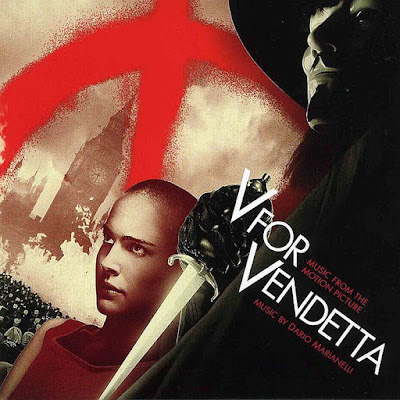


V For Vendetta 1 ( 75min mp3  34mb).


A novelisation of the film, written by Steve Moore and based on the Wachowskis' script, was published by Pocket Star on January 31, 2006 , and read here by Simon Vance.


xxxxx xxxxx xxxxx xxxxx xxxxx

previously

Terry Pratchett - The Colour of Magic part 1 ( 69min mp3     38mb).
Terry Pratchett - The Colour of Magic part 2 ( 69min mp3     38mb).
Terry Pratchett - The Colour of Magic part 3 ( 68min mp3     38mb).
Terry Pratchett - The Colour of Magic part 4 ( 69min mp3     38mb).
Terry Pratchett - The Colour of Magic part 5 ( 66min mp3     36mb).
Terry Pratchett - The Colour of Magic part 6 ( 69min mp3     36mb).
Terry Pratchett - The Colour of Magic movie ( 97min avi     698mb).

Terry Pratchett -  Light Fantastic part 1,2 ( 68min mp3     31mb).
Terry Pratchett -  Light Fantastic part 3,4 ( 68min mp3     31mb).
Terry Pratchett -  Light Fantastic part 5,6 ( 71min mp3     28mb).
Terry Pratchett -  Light Fantastic part 7,8 ( 71min mp3     28mb).
Terry Pratchett -  Light Fantastic part 9,10 ( 71min mp3     28mb).
Terry Pratchett -  Light Fantastic part 11,12 ( 63min mp3     28mb).
Terry Pratchett -  Light Fantastic Movie ( 91min avi     691mb).

xxxxx xxxxx xxxxx xxxxx xxxxx

Dec 9, 2019

RhoDeo 1949 Re Up 216

Hello,


11 correct requests for this week,1 too early,  1 unavailable (aetix-roots),  whatever another batch of 38 re-ups (12.5 gig)


These days i'm making an effort to re-up, it will satisfy a smaller number of people which means its likely the update will  expire relatively quickly again as its interest that keeps it live. Nevertheless here's your chance ... asks for re-up in the comments section at the page where the expired link resides, or it will be discarded by me. ....requests are satisfied on a first come first go basis. ...updates will be posted here remember to request from the page where the link died! To keep re-ups interesting to my regular visitors i will only re-up files that are at least 12 months old (the older the better as far as i am concerned), and please check the previous update request if it's less then a year old i won't re-up either.

Looka here , requests fulfilled up to Decemberrrr   8th... N'Joy

xxxxx xxxxx xxxxx xxxxx xxxxx


3x US Aetix Back In Flac (Minutemen - Post Mersh Vol. 1, Minutemen - Post Mersh Vol 2, Minutemen - Post Mersh Vol. 3)


4x Sundaze Back in Flac  (Angelo Badalamenti - Mulholland Drive, Angelo Badalamenti - O.S.T. Secretary, Angelo Badalamenti - O.S.T. Dark Water, Badalamenti & Lynch Archive part 6 )


24x US Aetix  Back in Flac (Hüsker Dü - Land Speed Record, Husker Du - Everything Falls Apart, Hüsker Dü - Zen Arcade, Hüsker Dü - New Day Rising )


3x Sundaze Back In Flac (Tuxedomoon - Half-Mute / Scream, Tuxedomoon - Desire,  Tuxedomoon - Suite En Sous-Sol + Time To Lose + Short Stories )


3x Aetix Back in Flac ( The Pop Group - Y, The Pop Group - For How Much Longer Do We Tolerate Mass Murder + We Are Time, VA - In Beginning There Was Rhythm  )


4x Grooves 1218 Back in Flac (Beastie Boys - Paul's Boutique, Beastie Boys - Check Your Head, Beastie Boys - Check Your Head bonus, Beastie Boys - Solid Gold Hits)


3x Grooves Back in Flac ( Abstract Funk Theory~Circulation, Abstract Funk Theory~Freddy Fresh, Abstract Funk Theory~Carl Graig )


4x Grooves Back in Flac (  Gare du Nord - In Search of Excellounge, Gare du Nord - Kind of Cool , Gare du Nord - Club Gare du Nord, Gare du Nord - Sex 'N' Jazz  )


4x Beats Back in Flac (  Soulwax - Hang All DJ's Volume 5 , Soulwax - Nite Versions, Soulwax - Most Of The Remixes, Rick James - Glow, Soulwax - Most Of The Remixes mixed)


2x Aetix Back in Flac (  OMD-Orchestral Manoeuvres In The Dark, OMD - Architecture & Morality )


4x Aetix Back in Flac (The Slits - Cut, The Slits - UnCut, The Slits - Return Of The Giant Slits, The Slits - Return Of The Giant Slits Dub-ble Discuss )


xxxxx xxxxx xxxxx xxxxx xxxxx

Dec 7, 2019

Sundaze 1949

Hello, so today we find the first 3 hours of Max's  8 hour long epos ..Sleep.... next week the remaining 5 hours, ideal music for winter-cocooning i guess, or falling asleep on the beach and waking up medium-rare , duh


Today's artist is is a German-born British composer who has been an influential voice in post-minimalist composition and in the meeting of contemporary classical and alternative popular musical styles since the early 2000s. Richter is classically trained, having graduated in composition from the Royal Academy of Music and studied with Luciano Berio in Italy.Richter also composes music for stage, opera, ballet and screen. He has also collaborated with other musicians, as well as with performance, installation and media artists. He has recorded eight solo albums and his music is widely used in cinema.  .......N-Joy

xxxxx xxxxx xxxxx xxxxx xxxxx

Combining the discipline of his classical background with the inventive spirit of electronic music, Max Richter's work as a producer and composer speaks to -- and frequently critiques -- 21st century life in eloquent and evocative ways. On early masterworks such as 2002's Memoryhouse and 2003's The Blue Notebooks, he united his childhood memories and commentary on war's devastating aftermath into gorgeous, aching music; with 2015's eight-hour Sleep, he challenged the increasing disposability of art and music as well as audiences' ever-decreasing attention spans. Richter's fascination with the growing role of technology in everyday life was a major theme of releases spanning 2008's collection of bespoke ringtones to the music for a particularly paranoid 2016 episode of the TV series Black Mirror. Despite the high-concept nature of much of his work, Richter always maintains a powerful emotional connection with his listeners; 2012's Recomposed: The Four Seasons, an experimental reimagining of Vivaldi's violin concertos, topped classical charts in over 20 countries. The emotive quality of his music translated perfectly to scoring and soundtrack work, which ranged from documentaries such as Waltz with Bashir (2008); feature films including Mary Queen of Scots (2018); television series like Taboo (2017); and stage productions including Infra (2008) and Woolf Works (2015), both projects with Richter's longtime collaborator, choreographer Wayne McGregor. Richter's mix of modern composition, electronic music, and field recordings was as influential as it was innovative, and paved the way for like-minded artists such as Nico Muhly and Jóhann Jóhannsson.

Born in West Germany in the mid-'60s, Richter and his family moved to the U.K. when he was still a little boy, settling in the country town of Bedford. By his early teens, he was listening to the canon of classical music as well as modern composers including Philip Glass, whose music was a major influence on Richter. The Clash, the Beatles, and Pink Floyd were also important, along with the early electronic music scene; inspired by artists such as Kraftwerk, Richter built his own analog instruments. He studied composition and piano at Edinburgh University, the Royal Academy of Music, and in Florence with Luciano Berio. He then became a founding member of the Piano Circus, a contemporary classical group that played works by Glass, Brian Eno, Steve Reich, Arvo Pärt, and Julia Wolfe, and also incorporated found sounds and video into their performances. After ten years and five albums for Decca/Argo, Richter left the group and became more involved in the U.K.'s thriving electronic music scene, collaborating with the Future Sound of London on 1996's Dead Cities (which features a track named after him) and The Isness; he also contributed orchestrations to Roni Size's 2000 album In the Mode.

Richter's own work evolved from the Xenakis-inspired music of his early days into something that included his electronic and pop influences. His 2002 debut album, Memoryhouse, introduced his mix of modern composition, electronica, and field recordings. Recorded with the BBC Philharmonic Orchestra, the album explored childhood memories as well as the aftermath of the Kosovo War in the 1990s and was hailed as a masterpiece. Two years later, Richter made his FatCat debut with The Blue Notebooks, which incorporated readings from Franz Kafka's Blue Octavo Notebooks and Polish writer Czesław Miłosz by actress Tilda Swinton into dreamlike pieces for strings and piano that touched on the Iraq War and Richter's early years. Released in 2006, Songs from Before paired his plaintive sound with texts written by Haruki Murakami and delivered by Robert Wyatt. In 2008, he issued 24 Postcards in Full Colour, a collection of intricate ringtones envisioned by Richter as a way to connect people around the world. That year also saw the release of his music for Ari Folman's Golden Globe-winning film Waltz with Bashir. Focusing on electronics instead of a typical orchestral score, it was Richter's highest-profile soundtrack project to date. He then worked on several other film scores, including music for Benedek Fliegauf's Womb, Alex Gibney's My Trip to Al-Qaeda, and David MacKenzie's Perfect Sense. Another scoring project, Infra, marked the beginning of Richter's enduring collaboration with choreographer Wayne McGregor. Commissioned by the Royal Ballet in 2008, Infra was a ballet inspired by by T.S. Eliot's classic poem "The Wasteland," and the the 2005 London terrorist bombings. Richter re-recorded and expanded his music for the 2010 album Infra, his fourth release for FatCat Records.


Richter began the 2010s with soundtrack work that included the award-winning scores to Die Fremde (2010) and Lore (2012). The composer reunited with McGregor for 2012's Sum, a chamber opera based on Sum: Forty Tales of the Afterlives, a collection of short stories by neuroscientist David Eagleman about the possibility of life after death. That year also saw the release of one of Richter's most popular albums, Recomposed by Max Richter: Vivaldi - The Four Seasons. An avant-garde, loop-based reworking of the composer's timeless set of violin concertos, it topped the classical charts in 22 countries, including the U.K., the U.S., and Germany. In turn, McGregor choreographed a ballet, Kairos, to Richter's recomposition. Disconnect, the score to Henry-Alex Rubin's film about the impact of technology on relationships, arrived in 2013. His other releases that year included the score to Wadjda, which was the first feature-length film made by a Saudi Arabian woman (director Haifaa Al-Mansour); the music to Ritesh Batra's The Lunchbox and Ruairí Robinson's sci-fi excursion The Last Days on Mars. Richter also worked with Folman again on the music to The Congress, an adaptation of Stanislaw Lem's novel The Futurological Congress.


In 2014, Richter launched a mentorship program for aspiring young composers and wrote music for HBO's The Leftovers, which also featured pieces from Memoryhouse and The Blue Notebooks. The following year saw the arrival of Sleep, an eight-hour ambient piece scored for piano, strings, electronics, and vocals that Richter described as a "lullaby for a frenetic world and a manifesto for a slower pace of existence." The piece premiered at a Berlin performance where the audience was given beds instead of seats. Sleep and From Sleep, a one-hour adaptation, were released in September 2015. The following year, Richter provided the score to the sci-fi/horror film Morgan and the disturbingly cheery music for "Nosedive," an episode of Black Mirror that took the all-consuming nature of social media to extremes. Released in January 2017, Three Worlds: Music from Woolf Works drew from his score for McGregor's 2015 Royal Ballet production inspired by three of Virginia Woolf's most acclaimed novels. It was followed that May by the soundtrack compilation Out of the Dark Room. That September, Richter's Emmy-nominated music for the BBC One drama Taboo was released.


Richter remained busy on soundtrack work in 2018, with projects including the music for the HBO TV series My Brilliant Friend as well as the scores to films like Hostiles, White Boy Rick, and Mary Queen of Scots, which won a Best Original Score -- Feature Film Award at the Hollywood Music in Media Awards. In October 2019, Deutsche Grammophon issued Voyager: Essential Max Richter, an expansive retrospective that included two previously unreleased pieces written for Sleep.


xxxxx xxxxx xxxxx xxxxx xxxxx

Max Richter embarks on many scoring projects -- most prominently, his music for the award-winning Israeli film Waltz with Bashir -- and it’s easy to hear why: albums such as The Blue Notebooks and Memoryhouse feel like, as the cliché about instrumental music goes, soundtracks for films that haven’t been made yet (though a piece from The Blue Notebooks was even used in the soundtrack to Martin Scorsese's Shutter Island). Like Bashir, an animated documentary about the 1982 Lebanon war, Infra is another high-concept project, a ballet inspired by T.S. Eliot's classic poem of yearning and regret, The Waste Land. In turn, Richter's score, which was originally 25 minutes but is expanded to 32 here, was influenced by Schubert's Winterreise. Even in its longer form, many of Infra's pieces are brief, recalling the brilliant miniatures of Richter's ringtone album 24 Postcards in Full Colour. Infra's palette is classic Richter, blending piano, brass, and a string quartet with electronic textures that span luminous washes to ghostly static that lends an alien quality, almost as if the listener is tuning into the score’s frequencies. Like The Waste Land, this music is subtle, its open-ended glimpses adding to its poignancy. Richter shows once again that he’s a master of conveying the maximum amount of emotions with the minimum amount of music: “Journey 4”'s melody teeters between despair and reassurance with almost every note. Despite -- or perhaps because of -- Infra's subtlety, it offers a wide-open backdrop for dancing. “Infra 8”'s tender swirls and “Infra 2”'s complementary arcs of strings and electronics suggest steps that flow or scuttle like a pair of ragged claws. Whether Richter explores abstract drones as on “Journey 3,” reminds listeners of what a sensitive player he is on piano-driven pieces such as “Journey 1” and “Infra 3,” or unites the work’s elements on major pieces like “Infra 5” and “Infra 7,” he does so with a masterful restraint that gives Infra's slate-gray moods maximum impact. This may be the most subdued of Richter's Fat Cat releases, but every nuance shows the care with which he crafts all of his music.


. Max Richter - Infra ( 195mb)

01 Infra 14:05
02 Journey 1 2:10
03 Infra 2 4:27
04 Infra 3 3:02
05 Journey 2 2:13
06 Infra 4 2:46
07 Journey 3 2:51
08 Journey 4 4:40
09 Journey 5 1:13
10 Infra 5 5:17
11 Infra 6 2:53
12 Infra 7 1:45
13 Infra 8 3:22

xxxxx xxxxx xxxxx xxxxx xxxxx

Antonio Vivaldi's Le Quattro Stagioni is one of the most beloved works in Baroque music, and even the most casual listener can recognize certain passages of "Spring" or "Winter" from frequent use in television commercials and films. Yet if these concertos have grown a little too familiar to experienced classical fans, Max Richter has disassembled them and fashioned a new composition from the deconstructed pieces. Using post-minimalist procedures to extract fertile fragments and reshape the materials into new music, Richter has created an album that speaks to a generation familiar with remixes, sampling, and sound collages, though his method transcends the manipulation of prerecorded music. Richter has actually rescored the Four Seasons and given the movements of Spring, Summer, Autumn, and Winter thorough makeovers that vary substantially from the originals. The new material is suggestive of a dream state, where drifting phrases and recombined textures blur into walls of sound, only to re-emerge with stark clarity and poignant immediacy. Violinist Daniel Hope is the brilliant soloist in these freshly elaborated pieces, and the Konzerthaus Kammerorchester Berlin is conducted with control and assurance by André de Ridder, so Richter's carefully calculated effects are handled with precision and subtlety. Deutsche Grammophon's stellar reproduction captures the music with great depth, breadth, and spaciousness, so everything that Richter and de Ridder intended to be heard comes across.


Max Richter - Recomposed  Vivaldi - The Four Seasons (flac 222mb)

01 Spring 0 0:42
02 Spring 1 2:31
03 Spring 2 3:19
04 Spring 3 3:09
05 Summer 1 4:11
06 Summer 2 3:59
07 Summer 3 5:01
08 Autumn 1 5:42
09 Autumn 2 3:08
10 Autumn 3 1:45
11 Winter 1 3:01
12 Winter 2 2:51
13 Winter 3 4:39

xxxxx xxxxx xxxxx xxxxx

 It seems that the regiment of sleeping concerts has arrived - meet the neoclassical interpretation of the concept of sleeping music from the British maestro of keys and strings.In fact, the public has heard such things many times already, so the idea, by itself, is far (and not at all) new, but it was most often static ambient things, and here the instrumental version is presented exactly the same as, at least, original at most - it sounds very intriguing.

Lasting a marathon eight hours, Richter builds a beautiful collage of piano, strings and choral pieces, drifting along with gentle ambiance for what is scientifically suggested to be the perfect length of a slumber. Incredibly it is never boring, rarely repetitive, always with a sense of emotion and melody often absent in minimalist works. Max’s “SLE” concept is based on a systematic repetition of lengthy harmonic passages enveloping and arranged around the leitmotifs periodically popping up along the sound of the album, here and there, imperceptibly connecting and appropriately accompanying the sound palette. At the exit from all this, a stunningly beautiful musical panorama of melodic suites of various keys is obtained. So who would have thought that would ever happen? At that very moment, when it seemed already that Max would never write anything better than his epoch-making Memoryhouse, he undertook and issued such a powerful release in depth and content that he would like not only to give the top line of the chart, but also, in principle, to call the best long-playing a concert. A reference sample of informative meditative music, and, perhaps, one of the most important (if not Home) works of Max Richter.


Max Richter - Sleep I (flac 234mb)

101 Dream 1 (Before The Wind Blows It All Away) 18:31
102 Cumulonimbus 10:09
103 Dream 2 (Entropy) 10:02
104 Path 3 (7676) 11:00
105 Whose Name Is Written On Water 11:15
+ 9 page PDF
xxxxx

Max Richter - Sleep II (flac 341mb)

201 Patterns (Cypher) 2:47
202 Solo 6:53
203 Aria 1 11:06
204 Return 2 (Song) 16:46
205 Nor Earth, Nor Boundless Sea 19:17
206 Dream 11 (Whisper Music) 18:54

xxxxx

Max Richter - Sleep III ( flac   319mb)

301 Moth-like Stars 29:00
302 Path 17 (Before The Ending Of Daylight) 26:52
303 Space 26 (Epicardium) 6:56
304 Patterns (Lux) 16:59

xxxxx xxxxx xxxxx xxxxx xxxxx


Dec 6, 2019

RhoDeo 1948 Grooves

Hello,


Today's Artist is Eric Lynn Wright (September 7, 1964 – March 26, 1995), known was an American rapper, record producer, and entrepreneur. Dubbed the "Godfather of Gangsta Rap", he gained prominence for his work with N.W.A, where he has been credited for pushing the boundaries of lyrical and visual content in mainstream popular music. ....... N Joy

xxxxx xxxxx xxxxx xxxxx xxxxx

Whether as a member of N.W.A, a solo act, or a label head, Eazy-E was one of the most controversial figures in gangsta rap. While his technical skills as a rapper were never the greatest, his distinctive delivery (invariably described as a high-pitched whine), over the top lyrics, and undeniable charisma made him a star. Following N.W.A's breakup, E's street credibility took a major beating, though his recordings continued to sell well when they appeared; unfortunately, he was diagnosed with AIDS in 1995, and died not long after.

Eric Wright was born to Richard and Kathie Wright on September 7, 1964, in Compton, California, a Los Angeles suburb noted for gang activity and crime.[12][13] His father was a postal worker and his mother was a grade school administrator.[14] Wright dropped out of high school in the tenth grade,[15] but later received a high-school general equivalency diploma (GED). No one survived on the streets without a protective mask. No one survived naked. You had to have a role. You had to be "thug," "playa," "athlete," "gangsta," or "dope man." Otherwise, there was only one role left to you: "victim."

Wright supported himself primarily by selling drugs, introduced to the occupation by his cousin. Wright's friend Jerry Heller admits that he witnessed Wright selling marijuana, but says that he never saw him sell cocaine. As Heller noted in his book Ruthless: A Memoir, Wright's "dope dealer" label was part of his "self-forged armor". Wright was also labeled as a "thug". Heller explains: "The hood where he grew up was a dangerous place. He was a small guy. 'Thug' was a role that was widely understood on the street; it gave you a certain level of protection in the sense that people hesitated to fuck with you. Likewise, 'dope dealer' was a role that accorded you certain privileges and respect." In 1986, at the age of 22, Wright had allegedly earned as much as US$250,000 from dealing drugs. However, after his cousin was shot and killed, he decided that he could make a better living in the Los Angeles hip hop scene, which was growing rapidly in popularity. He started recording songs during the mid-1980s in his parents' garage.

The original idea for Ruthless Records came when Wright asked Heller to go into business with him. Wright suggested a half-ownership company, but it was later decided that Wright would get eighty percent of the company's income and Heller would only get twenty percent. According to Heller, he told Wright, "Every dollar comes into Ruthless, I take twenty cents. That's industry standard for a manager of my caliber. I take twenty, you take eighty percent. I am responsible for my expenses and you're responsible for yours. You own the company. I work for you." Along with Heller, Wright invested much of his money into Ruthless Records. Heller claims that he invested the first $250,000 and would eventually put up to $1,000,000 into the company

N.W.A's original lineup consisted of Arabian Prince, Dr. Dre, Eazy-E, and Ice Cube. DJ Yella and MC Ren joined later. The compilation album N.W.A. and the Posse was released on November 6, 1987, and would go on to be certified Gold in the United States. The album featured material previously released as singles on the Macola Records label, which was responsible for distributing the releases by N.W.A and other artists like the Fila Fresh Crew, a West Coast rap group originally based in Dallas, Texas. Eazy-E's debut album, Eazy-Duz-It, was released on September 16, 1988, and featured twelve tracks. It was labeled as West Coast hip hop, gangsta rap and, later, as golden age hip hop. It has sold over 2.5 million copies in the United States and reached number forty-one on the Billboard 200. The album was produced by Dr. Dre and DJ Yella and largely written by MC Ren, Ice Cube and The D.O.C.. Both Glen Boyd from the Seattle Post-Intelligencer and MTV's Jon Wiederhorn claimed that Eazy-Duz-It "paved the way" for N.W.A's most controversial album, Straight Outta Compton. Wright's only solo in the album was a remix of the song "8 Ball", which originally appeared on N.W.A. and the Posse. The album featured Wright's writing and performing; he performed on seven songs and helped write four songs.

Ice Cube left N.W.A in 1989 because of internal disputes and the group continued as a four-piece ensemble. N.W.A released 100 Miles and Runnin' in 1990 and Niggaz4Life in 1991. A diss war started between N.W.A and Ice Cube when "100 Miles and Runnin'" and "Real Niggaz" were released. Ice Cube responded with "No Vaseline" on Death Certificate. Wright performed on seven of the eighteen songs on Niggaz4Life. In March 1991 Wright accepted an invitation to a lunch benefiting the Republican Senatorial Inner Circle, hosted by then-U.S. President George H. W. Bush. A spokesman for the rapper said that Eazy-E supported Bush because of his performance in the Persian Gulf War.

N.W.A began to split up after Jerry Heller became the band's manager. Dr. Dre recalls: "The split came when Jerry Heller got involved. He played the divide and conquer game. Instead of taking care of everybody, he picked one nigga to take care of and that was Eazy. And Eazy was like, 'I'm taken care of, so fuck it'." Dr. Dre and The D.O.C. sent Suge Knight to look into Eazy-E's financial situation as they began to grow suspicious of Eazy-E and Jerry Heller. Dr. Dre and The D.O.C. asked Eazy-E to release him from Ruthless, but Eazy-E refused. The impasse led to what reportedly transpired between Suge Knight and Eazy-E at the recording studio where Niggaz4life was recorded. After he refused to release Dr. Dre and The D.O.C., Suge Knight told Eazy-E that he had kidnapped Jerry Heller and was holding him prisoner in a van. This did not convince Eazy-E to release Dr. Dre and The D.O.C. from Ruthless, and Suge Knight threatened Eazy-E's family: Suge Knight gave Eazy-E a piece of paper that contained Eazy's mother's address, telling him, "I know where your mama stays." Eazy-E finally signed Dr. Dre and The D.O.C.'s releases, officially ending N.W.A. The feud with Dr. Dre continued after a track on Dre's debut album The Chronic, "Fuck wit Dre Day (And Everybody's Celebratin')", contained lyrics that insulted Eazy-E. Eazy responded with the EP, It's On (Dr. Dre) 187um Killa, featuring the tracks "Real Muthaphuckkin G's" and "It's On". The EP, which was released on October 25, 1993, contains pictures of Dre wearing "lacy outfits and makeup" when he was a member of the Electro-hop World Class Wreckin' Cru.

On February 24, 1995, Wright was admitted to the Cedars-Sinai Medical Center in Los Angeles with a violent cough. He was diagnosed with HIV/AIDS. He announced his illness in a public statement on March 16, 1995. It is believed Wright contracted the infection from a sexual partner. During the week of March 20, having already made amends with Ice Cube, he drafted a final message to his fans. On March 26, 1995, Eazy-E died from complications of AIDS, one month after his diagnosis. He was 30 years old (most reports at the time said he was 31 due to the falsification of his date of birth by one year). He was buried on April 7, 1995, at Rose Hills Memorial Park in Whittier, California. Over 3,000 people attended his funeral, including Jerry Heller and DJ Yella. He was buried in a gold casket, and was dressed in a flannel shirt, jeans, and his Compton hat. On January 30, 1996, ten months after Eazy-E's death, his final album, Str8 off tha Streetz of Muthaphukkin Compton was released.

In 2015, the critically acclaimed, Academy-Award-nominated N.W.A. biopic Straight Outta Compton was released in theaters. Focusing on the creation and rise of the seminal gangsta rap crew, Compton was dedicated to Eazy. It went on to make over $200 million worldwide at the box office and inspired a cultural resurgance for N.W.A. With increased mainstream recognition of N.W.A.'s legacy in the history of rap and hip-hop, Eazy received a posthumous honor for his contribution to music with his posthumous induction into the Rock 'N Roll Hall of Fame in 2016.

Wright had a son, Eric Darnell Wright (known as Lil Eazy-E), in 1984. He also had a daughter named Erin who has legally changed her name to Ebie. In October 2016 she launched a crowd-funding campaign to produce a film called Ruthless Scandal: No More Lies to investigate her father's death. It ended unsuccessfully in December 2016. Wright met Tomica Woods at a Los Angeles nightclub in 1991 and they married in 1995, twelve days before his death. They had a son named Dominick and a daughter named Daijah (born six months after Wright's death). After Wright's death, Ruthless was taken over by his wife. According to Jerry Heller, Wright had 11 children with eight different women. According to his son Lil Eazy-E, Eazy-E was worth an estimated USD$50 million at the time of his death.

xxxxx xxxxx xxxxx xxxxx xxxxx

Released only a month after Straight Outta Compton (1988), Eazy-Duz-It was the first N.W.A spin-off album. Years before Ice Cube went solo with Amerikkka's Most Wanted (1990), before Dr. Dre changed the rap game with The Chronic (1992), before MC Ren struggled to establish himself with Shock of the Hour (1993), and before Yella simply fell into obscurity, Eazy-E rose to immediate superstar status with this solo debut. It's no wonder why, for the album plays like a humorous, self-centered twist on Straight Outta Compton with Eazy-E, the most charismatic member of N.W.A, front and center while his associates are busy behind the scenes, producing the beats and writing the songs. In terms of production, Dr. Dre and Yella meld together P-Funk, Def Jam-style hip-hop, and the leftover electro sounds of mid-'80s Los Angeles, creating a dense, funky, and thoroughly unique style of their own. In terms of songwriting, the D.O.C., Ice Cube, and MC Ren are each credited; plus, Ren performs raps of his own on five of the 12 songs. The collaborative nature of the music -- with Dre and Yella producing; the D.O.C., Ice Cube, and MC Ren writing the songs; MC Ren featured as a guest on half of them; and Eazy-E performing -- fortunately makes Eazy-Duz-It more of an N.W.A effort than a true solo album. This is fortunate because as charismatic as he may be, Eazy-E isn't an especially gifted MC. He's at his best here when he's cracking wise and also when he's overshadowed by Dr. Dre's productions, particularly on the four-song sequence of "Eazy Duz It," "We Want Eazy," "Eazy-er Said Than Dunn," and "Radio" -- all heavily produced songs with layers upon layers of samples and beats competing with Eazy-E's rhymes for attention. Straight Outta Compton is no doubt the more revolutionary album, yet Eazy-Duz-It is a great companion, showcasing N.W.A's sense of humor and, despite the often violent subject matter, casting them in a lighter, more humorous mood. When Eazy-E would return with a second solo release, 5150 Home 4 tha Sick, his N.W.A associates would be M.I.A. and the difference would be stark.


 Eazy-E - Eazy-Duz-It  (flac   325mb)

01 (Prelude) / Still Talkin' 3:50
02 Nobody Move (Feat MC Ren) 4:49
03 Ruthless Villain 2:59
04 2 Hard Mutha's (Feat MC Ren) 4:26
05 Boyz-N-The Hood (Remix) 6:22
06 Eazy-Duz-It 4:21
07 We Want Eazy (Feat MC Ren, Dr. Dre) 5:01
08 Eazy-Er Said Than Dunn 3:41
09 Radio 4:58
10 No More ?'s 3:55
11 I'mma Break It Down 3:29
12 Eazy Chapter 8 Verse 10 2:10

xxxxx xxxxx xxxxx xxxxx xxxxx

Distanced from Dr. Dre and Ice Cube, the two artists most responsible for his own success, Eazy-E doesn't have a lot going for him on 5150 Home 4 tha Sick. Released in late 1992, two weeks after Dr. Dre reinvented himself on The Chronic, this brief EP finds Eazy-E in a desperate scenario. He hadn't released any solo material since his 1988 debut album, Eazy-Duz-It, and the runaway success of his former N.W.A associates no doubt left many to wonder what had happened to Eazy-E, who at one point had been the star of the group. The five songs on 5150 unfortunately don't do much to reclaim Eazy's once mighty stature among the gangsta rap scene, especially since "Intro: New Year's E-Vil" clocks in under a minute and "Merry Muthafuckin' Xmas" is a novelty. The remaining songs ("Only If You Want It," "Neighborhood Sniper," "Niggaz My Height Don't Fight") are thankfully good and, above all, curious for how they differ in style from Eazy-E's past work, which had been exclusively produced by Dr. Dre. Three good songs isn't much more than a teaser, however, or more cynically, a stopgap. Overall, there's not much to 5150 Home 4 tha Sick (which, to be fair, prints "maxi-single" in large print on the cover), for the absence of Dr. Dre's production and Ice Cube's and MC Ren's ghostwriting reveals Eazy-E to be a much different, less creative artist than before -- and in a rather uncomfortable position, commercially.

Released a year after his previous EP (5150 Home 4 tha Sick, 1992) and a long five years since his one and only album to date (Eazy-Duz-It, 1988), It's On (Dr. Dre) 187um Killa was both a stopgap release for Eazy-E and a response to the runaway success of Dr. Dre's The Chronic (1992). Eazy had been lambasted on that Dr. Dre album (and especially in the "Dre Day" video), so it's no surprise that he returns the favor here on "Real Muthaphuckkin G's" and "It's On," dissing not only Dre but also Snoop Doggy Dogg. This ugly, mudslinging conflict aside, Eazy truly shines on these eight songs. Granted, eight songs isn't a lot of music, especially since one of the eight is only a minute-long intro and another is yet another remake of "Boyz-in-the Hood" (and too because Eazy had been so AWOL in previous years -- five years and still no follow-up album to Eazy-Duz-It!?!). On the little bit of music that is here, however, Eazy proves that he's still one of the best gangsta rappers out there in the early '90s. Sure, he's not an especially gifted MC, and he's not nearly as witty or perversely humorous as he had been previously on Eazy-Duz-It, either, but he has such a singular style and such attitude, he stands out amid the innumerable other gangstas out there at the time. And to elaborate upon his attitude, Eazy seems downright bitter here. The success of Dr. Dre and Ice Cube outside of N.W.A, not to mention the dissolution of that group, seems to have really upset him. So in a way, It's On feels cathartic, as if Eazy were venting all his frustrations. It results in a sharp group of songs: there are the Dre disses, of course, but also the murder fantasy of "Any Last Werdz," the f*ck-the-world nihilism of "Still a Nigga," the sexist porno-dance of "Gimmie That Nutt," and the smoke-out of "Down 2 tha Last Roach." In other words, pretty much what you'd expect from Eazy. Yet there's an underlying current of irony here that makes It's On all the more poignant in retrospect. For one, Eazy may be dissing Dre to the extreme here, but pretty much all of the production work is straight from the Chronic playbook -- textbook G-funk, to the point it seems almost parodic. And secondly, the heedless promotion of sexism here is downright haunting in the aftermath of Eazy's subsequent death from AIDS complications little more than a year later. So while on the surface It's On may seem like a simple stopgap EP, it's so much more, shedding light on what came of Eazy following his 15 minutes of fame with Eazy-Duz-It.


Eazy-E - 5150 Home 4 tha Sick +  It's On (Dr. Dre) 187um Killa (EP)  (flac   380mb)

5150 Home 4 tha Sick (EP)
01 Intro: New Year's E-vil 0:49
02 Only If You Want It 3:03
03 Neighborhood Sniper 5:12
04 Niggaz My Height Don't Fight 3:14
05 Merry Muthafuckin' Xmas 5:54

It's On (Dr. Dre) 187um Killa (EP)
06 Exxtra Special Thankz 1:06
07 Real Muthaphuckkin G's 5:33
08 Any Last Werdz 5:11
09 Still A Nigga 4:10
10 Gimmie That Nutt 2:59
11 It's On 5:02
12 Boyz N Tha Hood (G-Mix) 5:36
13 Down 2 Tha Last Roach 7:51

xxxxx xxxxx xxxxx xxxxx xxxxx

At the time of his death, Eazy-E was completing a comeback album that was intended to restore his street credibility, which had taken a savage beating in the early '90s. Str8 Off tha Streetz of Muthaphu**in Compton, the album he left unfinished, does show more ambition than his previous It's On, but it's unlikely that it would have made him a star again. Eazy's final album is definitely a grower. At first I was thrown off by it, because it was slightly different than his other material, but as far as posthumous albums go, I wasn't expecting much. Well, on my 2nd listen I was already loving it. True, this isn't quite as good as it could have been, but if you take it for what it is, you have a pretty solid gangsta rap album. Eazy's rapping is still excellent on here, as he kills every track with his hilarious style that we love him for. Similar to Niggaz4Life, Eazy-E is just nihilistic and misogynistic here. On one half of the album he brags about murder and sometimes even gets psychopathic like with "Sorry Louie" and on the rest of the album he disses his baby mama, hookers and bitches in general. Eazy-E is now also writing his own lyrics and he's not as bad as one would expect a rapper that has just picked up a pen. His Ruthless proteges appear throughout, but it's still Eazy who's dominating this. Never really a gifted rapper, he made up for his limitations with the energy, attitude and unique high-pitched voice that can never be duplicated. The production which is done by in-house Ruthless producers like DJ Yella, Rhythm D and (I think) Cold 187um balances between the pre-The Chronic funk west coast sound and g-funk. Some beats are chaotic with the aggressive, raw funk sound that Dr. Dre sort of debuted in Niggaz4Life while the rest of the beats are on the g-funk tip with heavy synthesizers. The beats are pretty good and Eazy-E is not bad at all. What really holds this album back is it's incomplete feel in general.Sadly, the album isn't the graceful departure it might have been.


Eazy-E - Str8 off tha Streetz of Muthaphukkin Compton (flac   355mb)

01 First Power 0:46
02 Ole School Shit 4:00
03 Sorry Louie 4:03
04 Just Tah Let U Know 4:08
05 Sippin' On A 40 4:29
06 Nutz On Ya Chin 3:09
07 Tha Muthaphukkin Real 4:20
08 Lickin, Suckin, Phuckin 2:24
09 Hit The Hooker 2:52
10 My Baby'z Mama 3:43
11 Creep N Crawl 4:11
12 Wut Would You Do 5:51
13 Gangsta Beat 4 Tha Street 3:40
14 Eternal E 5:26

 xxxxx xxxxx xxxxx xxxxx xxxxx

Eazy-E enjoyed only a brief recording career, but the few albums and EPs he did release -- on his own as well as with his group, N.W.A -- were tremendously influential, setting the stage for the proliferation of West Coast gangsta rap in the early '90s. Showcasing some of the pioneering gangsta's most influential recordings, Eternal E serves as a summary of Eazy's solo highlights, including a couple N.W.A songs but only ones that were solo showcases. You get the standout songs from Eazy's debut album, Eazy-Duz-It (1988), as well as the bulk of his follow-up EP, 5150 Home 4 tha Sick (1992). But Eternal E stops there, unfortunately not including anything from the first-rate It's On (Dr. Dre) 187um Killa EP or the third-rate Str8 off tha Streetz album. (Eazy's label, Ruthless, left its parent label, Priority, at this point, and Eternal E is a Priority release, meaning that post-Priority recordings such as those on It's On would have to be licensed for inclusion here -- a price the label seems unwilling to pay.) Even if Eternal E doesn't round up a full career retrospective, it does feature Eazy's key songs, namely his earliest ones, which boasted cutting-edge production work by Dr. Dre. So this best-of does serve its purpose fairly well, and might be the only Eazy album you'll need. Still, if it's one and only one Eazy album you want, you'd be better off with Priority's Eazy-Duz-It reissue from 2002, which includes that entire album plus the entire 5150 EP appended as bonus tracks -- giving you mostly everything here and much more. Either way though, you're getting a good portrait of Eazy's best solo music, with the exception of the It's On EP, which you'll definitely want to hear if you're a fan.


Eazy-E - Eternal E (Gangsta Memorial Edition)  (flac   508mb)

01 Boyz-N-The-Hood (remix) 6:22
02 8 Ball 4:52
03 Eazy-Duz-It 4:21
04 Eazy-er Said Than Dunn 3:41
05 No More ?'s 3:56
06 We Want Eazy 5:01
07 Nobody Move 4:48
08 Radio 4:59
09 Only If You Want It 3:02
10 Neighborhood Sniper 5:12
11 I'd Rather Fuck You 3:59
12 Automobile 3:18
13 Niggaz My Height Don't Fight 3:17
14 Eazy Street 4:27

xxxxx xxxxx xxxxx xxxxx xxxxx

A hodgepodge of both obscure and well-known Eazy-E recordings, Featuring...Eazy E is ostensibly a compilation of tracks on which the late rapper was featured as a guest. That explains the inclusion of "Trust No Bitch" (Penthouse Players Clique), "Get Yo Ride On" (Mack 10), "Foe tha Love of Money" (Bone Thugs-N-Harmony), and "P.S. Phuk U 2" (Penthouse Players Clique), which are all tracks on which Eazy-E was a featured guest. However, every other song on this 16-track compilation was originally credited to either Eazy-E or his group, N.W.A, so Featuring...Eazy E falls far short of fulfilling its literal billing. If anything, the compilation functions well as a clearinghouse of obscure Eazy-E material in remastered sound: the two aforementioned Penthouse Players Clique tracks, from the long out of print DJ Quik-produced Paid the Cost (1992); "L.A. Is the Place" and "Fat Girl," both produced by Dr. Dre, from the formative N.W.A and the Posse (1987); the 12" remix of "We Want Eazy," which clocks in at nearly seven minutes; "Luv 4 Dem Gangsta'z," a latter-day one-off contribution to the Beverly Hills Cop III soundtrack (1994); and a pair of posthumous productions by L.T. Hutton, "24 Hrs to Live" and "Black Nigga Killa," originally released on the double-disc retrospective Ruthless Records Tenth Anniversary: Decade of Game (1998). Besides this obscure material and the aforementioned guest features, Featuring...Eazy E also includes well-known songs from Eazy-Duz-It (1988) and Niggaz4life (1991) that are among the best songs here, but because they've been so often compiled, they essentially serve as filler. To further muddy the logic of the material compiled, Featuring...Eazy E is sequenced non-chronologically.


VA - Featuring... Eazy-E  (flac   483mb)

01 Eazy-E - Luv 4 Dem Gangsta'z 4:35
02 Eazy-E With M.C. Ren - 2 Hard Mutha's 4:25
03 Penthouse Players Clique - Trust No Bitch 5:03
04 Eazy-E With Ron-De-Vu - L.A. Is The Place 4:34
05 N.W.A. - Findum, Fuckum & Flee 3:56
06 Mack 10 - Get Yo Ride On 3:31
07 Eazy-E -Black Nigga Killa 4:48
08 Eazy-E - We Want Eazy (12" Remix) 6:39
09 Bone Thugs-N-Harmony - Foe Tha Love Of $ 4:11
10 N.W.A. - I'd Rather Fuck You 3:58
11 Eazy-E - 24 Hrs To Live 4:43
12 Eazy-E - Boyz In Tha Hood (G Mix) 5:39
13 Eazy-E With Ron-De-Vu - Fat Girl 2:50
14 N.W.A. - Automobile 3:17
15 Penthouse Players Clique - P.S. Phuk U 2 3:24
16 Eazy-E With M.C. Ren - Ruthless Villain 2:58

xxxxx xxxxx xxxxx xxxxx xxxxx

Dec 3, 2019

RhoDeo 1948 Lights 7

Hello, the search for dark matter gets into almost insane proportions this week after their previous candidate WIMP (weakly interactive particle) fell through as a candidate of the imagined dark matter that keeps their gravitation formulas alive, another name Axions pops up: The axion is a hypothetical elementary particle postulated by the Peccei–Quinn theory in 1977 to resolve the strong CP problem in quantum chromodynamics (QCD). If axions exist and have low mass within a specific range, they are of interest as a possible component of cold dark matter." It must be real, please God let it be real I don't want to belong to the losers that went astray."
Pity those 'brilliant' minds that barked up the wrong tree for almost a 100 years now, ignoring the truth because it was too simple ? The Universe Is Electric !


xxxxx xxxxx xxxxx xxxxx xxxxx

The Healing Frequency Music Project was created to promote positive, healthy change. Seven unique songs recorded in seven unique frequencies on seven CDs results in 2.5 hours of beautiful, transformational music. Listeners say that Wholetones facilitates restorative sleep and brings a tangible sense of peace that permeates their home. Entrepreneurs have reported increased focus and productivity, leading to breakthrough ideas. Artists, musicians, and writers are experiencing heightened levels of creativity and vision. Wholetones is ideal music for: prayer rooms, hospice care facilities, nursing homes, hospitals, waiting rooms, offices, family counselors, massage therapists, schools, and more. Seven discs include: Open Door (396Hz), Desert Sojourn (417Hz), The Key of David (444Hz), Transformation (528Hz), The Bridge (639Hz), Great Awakening (741Hz), The Majestic (852Hz). And as an added bonus, I'm also including my brand new book – Wholetones: The Sound of Healing. It's 142 pages of life-changing personal revelation... a virtual key to unlock your hidden potential. This book is the perfect companion to accompany the music as it demystifies the science behind the frequencies and explains how to get the most out of your listening experience. There is even a chapter that shows musicians how to recalibrate their instruments to play in the 7 healing frequencies. Truly an inspirational journey into the spiritual realm of healing and much, much more...


1. Wipe out your unhealthy fears, drop feelings of guilt and shame, and show you how you can help restore your liver, brain, and kidney functions...(SONG 1, 396Hz)
2. Remove the recurring, negative cycles in your life like procrastination, addiction, and junk food...watch as sluggishness and lethargy disappear and productivity and creativity increase...enhance your digestion, ease stomach issues, balance your metabolism, and erase headaches and lower back pain...(SONG 2, 417Hz)
3. Discover the Master Key that precipitates all other frequencies. You'll feel soothed by its multiple health benefits as you're tenderly enveloped in peace. This is the very same frequency David used to soothe King Saul's depression...(SONG 3, 444Hz )
4. Hear the most curious frequency of all...this has the power to restore broken DNA. This is the root of disease. Relax and let the transformation lift you to a seemingly unreachable height...gently relieving hormonal imbalances, muscle tension, weight problems, and and circulation troubles...(SONG 4, 528Hz)
5. Enjoy the fostering of peace and forgiveness in all your relationships. Also known to positively affect the endocrine system – particularly gall bladder and adrenal issues...(SONG 5, 639Hz)
6. Gain a keen awareness of your very own spirit in this powerful yet delicately performed miracle of healing. Experience deep spiritual and emotional healing while cleansing your immune system of common infections. Super-charge your circulatory system to support your healthy heart and blood flow...(SONG 6, 741Hz)
7. Revel in the frequency that celebrates the King of Kings. Purely spiritual – connect in the worship of God, His love for humankind, and His return to those who await Him...(SONG 7, 852Hz)
As you read this, I’ve been playing - Transformation, at 528 Hz. Feel the vibrations in your body ... I thought it was the perfect sample to welcome you to this amazing product..


Wholetones The Sound of Healing   ( 7x 22:00min   mp320   360mb)

1.Open Door (396Hz) – This beautiful piece literally opens you up to receive the healing. Supports blood, liver function, bones, brain health and kidney function.
2.Desert Sojourn (417Hz) – Increased energy has been reported as well as productivity and creativity... supports issues of the stomach – especially digestion. It can also positively affect gallbladder, metabolism, headaches, and lower back pain.
3.The Key of David (444Hz) – The master key with multiple health benefits. Establishes peace amid chaos. Hint – listen to this when you're feeling overwhelmed and anxious.
4.Transformation (528Hz) – Restore your broken DNA – the very root cause of illness and disease. Balance your hormones, gently lift your heart, muscles, and lymphatic system.
5.The Bridge (639Hz) – Fosters forgiveness and peace in your relationships boosts your endocrine system and heals your adrenal glands and gallbladder.
6.Great Awakening (741Hz) – Provides you with deep spiritual and emotional healing. Become aware of your spirit within while gently cleansing your immune system.
7.The Majestic (852Hz) – Purely spiritual this magnificent piece is a celebration of the King of Kings. Join us in sharing His love for humankind and those who await his grand return.

+ 2 Whole Tones PDF's


xxxxx xxxxx xxxxx xxxxx xxxxx

A double short and clear bill this week, about our sun

It is generally not known that an alternative Electric Sun model was proposed in 1979 by the engineer Ralph Juergens. It explains simply the critical longevity of all electric lights — it is plugged into a galactic circuit. And galactic circuits are the basis of Plasma Cosmology, which is ignored by astrophysicists but was developed by experimental plasma scientists and engineers in the 20th century. Plasma Cosmology is simply explanative and has proven to be predictive — quite unlike mathematical big bang cosmology. Only in the last few years have the circumstances arisen to enable the more recent Electric Sun model to be tested. Called the SAFIRE Project, the cutting edge engineering firm Aurtas International Inc. was contracted by The International Science Foundation to experimentally test the Electric Sun Model. Aurtas International Inc. is an independent body, which has no affiliation with The Electric Universe or The Thunderbolts Project. Recently, the SAFIRE team shared an extraordinary update on their results to date. In part one of this two-part presentation, our chief science advisor, physicist Wal Thornhill, discusses the SAFIRE experiment, its results and its promise for the future.


In part one of this presentation, physicist Wal Thornhill began his analysis of the recent remarkable update by the team behind the groundbreaking scientific experiment, the SAFIRE Project. For the first time, an independent experiment has been conducted to audit the Electric Sun model, first proposed by the engineer Ralph Juergens in the 1970’s. SAFIRE’s principal scientist and chief engineer Montgomery Childs recently said of SAFIRE’s results: “In all our experiments and discoveries we have found no disparities with the Electric Sun model. We believe the SAFIRE experiment validates and supports the Electric Sun model.” Childs is President and Founder of the engineering firm Aurtas International Inc., which was contacted by the International Science Foundation to experimentally test the Electric Sun model. As noted previously, Aurtas International Inc. is an independent body, which has no affiliation with The Electric Universe or The Thunderbolts Project. In this episode, Thornhill continues with his thoughts on some of the most stunning SAFIRE results to date.


xxxxx xxxxx xxxxx xxxxx xxxxx


Today the TV version of 2nd sc-world tale Light Fantastic..... N-Joy


Sir Terence David John Pratchett OBE (28 April 1948 – 12 March 2015) was an English author of fantasy novels, especially comical works. He is best known for his Discworld series of 41 novels.

Pratchett's first novel, The Carpet People, was published in 1971. The first Discworld novel, The Colour of Magic, was published in 1983, after which Pratchett wrote an average of two books a year. His 2011 Discworld novel Snuff became the third-fastest-selling hardback adult-readership novel since records began in the UK, selling 55,000 copies in the first three days. The final Discworld novel, The Shepherd's Crown, was published in August 2015, five months after his death.

Pratchett, with more than 85 million books sold worldwide in 37 languages, was the UK's best-selling author of the 1990s. He was appointed Officer of the Order of the British Empire (OBE) in 1998 and was knighted for services to literature in the 2009 New Year Honours. In 2001 he won the annual Carnegie Medal for The Amazing Maurice and his Educated Rodents, the first Discworld book marketed for children. He received the World Fantasy Award for Life Achievement in 2010.

In December 2007, Pratchett announced that he had been diagnosed with early-onset Alzheimer's disease. He later made a substantial public donation to the Alzheimer's Research Trust (now Alzheimer's Research UK), filmed a television programme chronicling his experiences with the condition for the BBC, and became a patron for Alzheimer's Research UK. Pratchett died on 12 March 2015, aged 66.


xxxxx xxxxx xxxxx xxxxx xxxxx

Discworld is a comic fantasy book series written by the English author Terry Pratchett, set on the Discworld, a flat planet balanced on the backs of four elephants which in turn stand on the back of a giant turtle. The books frequently parody or take inspiration from J. R. R. Tolkien, Robert E. Howard, H. P. Lovecraft, Charles Dickens and William Shakespeare, as well as mythology, folklore and fairy tales, often using them for satirical parallels with cultural, political and scientific issues.

Forty-one Discworld novels have been published. The original British editions of the first 26 novels, up to Thief of Time (2001), had cover art by Josh Kirby. The American editions, published by Harper Collins, used their own cover art. Since Kirby's death in 2001, the covers have been designed by Paul Kidby. Companion publications include eleven short stories (some only loosely related to the Discworld), four popular science books, and a number of supplementary books and reference guides. The series has been adapted for graphic novels, theatre, computer and board games, and television.

Newly released Discworld books regularly topped The Sunday Times best-sellers list, making Pratchett the UK's best-selling author in the 1990s. Discworld novels have also won awards such as the Prometheus Award and the Carnegie Medal. In the BBC's Big Read, four Discworld novels were in the top 100, and a total of fourteen in the top 200. More than 80 million Discworld books have been sold in 37 languages

xxxxx

The Light Fantastic is a comic fantasy novel by Terry Pratchett, the second of the Discworld series. It was published on 2 June 1986, the first printing being of 1,034 copies. The title is a quote from a poem by John Milton and in the original context referred to dancing lightly with extravagance. The events of the novel are a direct continuation of those in the preceding book, The Colour of Magic (the only Discworld novel to follow on in this manner).

xxxxx

Setting

The story takes place on the Discworld, a planet-sized flat disc carried through space on the backs of four gargantuan elephants – Berilia, Tubul, Great T'Phon and Jerakeen – who themselves stand on the shell of Great A'Tuin, a gigantic sea turtle. The surface of the disc contains oceans and continents, and with them, civilizations, cities, forests and mountains.

The Light Fantastic begins shortly after the ending of The Colour of Magic, with wizard Rincewind, Twoflower and the Luggage falling from the Discworld. They are saved when the Octavo, the most powerful book of magic on the Discworld, readjusts reality to prevent the loss of one of its eight spells, which has resided in Rincewind's head since his expulsion from Unseen University: Rincewind, Twoflower and the Luggage end up in the Forest of Skund. Meanwhile, the wizards of Ankh-Morpork use the Rite of Ashk-Ente to summon Death to find an explanation for the Octavo's actions. Death warns them that the Discworld will soon be destroyed by a huge red star unless the eight spells of the Octavo are read.

Several orders of wizards travel to the forest of Skund to try and capture Rincewind, who is currently staying with Twoflower and the Luggage in a gingerbread house in the forest. In the subsequent chaos, Rincewind and Twoflower escape on an old witch's broom, while the Archchancellor of Unseen University is killed when his attempt to obtain the spell accidentally summons the Luggage on top of him, crushing him to death. His apprentice, Ymper Trymon, uses the opportunity to advance his own power, intending to obtain the eight spells for his own good.

Rincewind and Twoflower run into a group of druids who have assembled a "computer" formed from large standing stones, and learn of the approaching red star. As Twoflower attempts to stop the druids from sacrificing a young woman named Bethan, Cohen the Barbarian, an octogenarian parody of Conan, attacks the druids. Twoflower is poisoned in the battle, forcing Rincewind to travel to Death's Domain to rescue him. The pair narrowly avoid being killed by Ysabell, Death's adopted daughter, and as they escape Death's Domain, Rincewind learns from the Octavo itself that it had arranged for its eighth spell to escape into his head, to ensure the spells would not be used before the right time.

Rincewind and Twoflower travel with Cohen and Bethan to a nearby town, where the toothless Cohen leaves to have some dentures made for him, having learned of them from Twoflower. While he is gone, Rincewind, Twoflower and Bethan are attacked by a mob of people who believe the star is coming to destroy the Discworld in response to the presence of magic. The trio escape into one of many shops that sell strange and sinister goods and inexplicably vanish the next time a customer tries to find them. The existence of these shops is explained as being a curse by a sorcerer upon the shopkeeper for not having something in stock. They are able to return to Ankh-Morpork via the shop.

As the star comes nearer and the magic on the Discworld becomes weaker, Trymon tries to put the seven spells still in the Octavo into his mind, in an attempt to save the world and gain ultimate power. However, the spells prove too strong for him and his mind becomes a door into the "Dungeon Dimensions", home to all manner of eldritch creatures. Rincewind and Twoflower manage to kill the now-mutated Trymon, and Rincewind reads all eight of the Octavo's spells aloud. This causes eight moons of the red star to crack open and reveal eight tiny world-turtles that follow their parent A'Tuin on a course away from the star. The Octavo then falls and is eaten by the Luggage.

Twoflower and Rincewind part company as Twoflower decides to return home, leaving the Luggage with Rincewind as a parting gift. Cohen and Bethan also leave to get married. Rincewind decides to re-enroll in the university, believing that with the spell out of his head, he will finally be able to learn magic.


Terry Pratchett -  Light Fantastic Movie ( 91min avi     691mb).


Light Fantastic Movie 91min


xxxxx xxxxx xxxxx xxxxx xxxxx

previously

Terry Pratchett - The Colour of Magic part 1 ( 69min mp3     38mb).
Terry Pratchett - The Colour of Magic part 2 ( 69min mp3     38mb).
Terry Pratchett - The Colour of Magic part 3 ( 68min mp3     38mb).
Terry Pratchett - The Colour of Magic part 4 ( 69min mp3     38mb).
Terry Pratchett - The Colour of Magic part 5 ( 66min mp3     36mb).
Terry Pratchett - The Colour of Magic part 6 ( 69min mp3     36mb).
Terry Pratchett - The Colour of Magic movie ( 97min avi     698mb).

Terry Pratchett -  Light Fantastic part 1,2 ( 68min mp3     31mb).
Terry Pratchett -  Light Fantastic part 3,4 ( 68min mp3     31mb).
Terry Pratchett -  Light Fantastic part 5,6 ( 71min mp3     28mb).
Terry Pratchett -  Light Fantastic part 7,8 ( 71min mp3     28mb).
Terry Pratchett -  Light Fantastic part 9,10 ( 71min mp3     28mb).
Terry Pratchett -  Light Fantastic part 11,12 ( 63min mp3     28mb).

xxxxx xxxxx xxxxx xxxxx xxxxx

Dec 2, 2019

RhoDeo 1948 Re Up 215

Hello,


6 correct requests for this week,1 too early,  1 unavailable (aetix-roots), 1 stupid insult, whatever another batch of 22 re-ups (7.2 gig)


These days i'm making an effort to re-up, it will satisfy a smaller number of people which means its likely the update will  expire relatively quickly again as its interest that keeps it live. Nevertheless here's your chance ... asks for re-up in the comments section at the page where the expired link resides, or it will be discarded by me. ....requests are satisfied on a first come first go basis. ...updates will be posted here remember to request from the page where the link died! To keep re-ups interesting to my regular visitors i will only re-up files that are at least 12 months old (the older the better as far as i am concerned), and please check the previous update request if it's less then a year old i won't re-up either.

Looka here , requests fulfilled up to Decemberrrr   1st... N'Joy

xxxxx xxxxx xxxxx xxxxx xxxxx


4x Sundaze Back In Flac (Susumo Yokota - Cat, Mouse And Me, Susumu Yokota - Magic Thread, Susumu Yokota - Sakura, Susumu Yokota - Symbol )


6x US Aetix Back in Flac  (Butthole Surfers - EP & Live PCPPEP, Butthole Surfers - Psychic... Powerless.., Butthole Surfers - RembrandtPussyhorse, Butthole Surfers - Hairway To Steven, Butthole Surfers - Locust Abortion Technician, Butthole Surfers - Widowermaker! (EP) )


4x US AEtix  Back in Flac (Minutemen - Double Nickels on the Dime, Minutemen - 3-Way Tie (For Last), Minutemen - Ballot Result)


2x Sundaze Back in Flac ( Stereolab - Emperor Tomato Ketchup, Stereolab - Transient Random-Noise Bursts With Announcements )


4x Grooves Back In Flac (Abstract Funk Theory ~ Colin Dale, Abstract Funk Theory ~ Ross Allen,  Abstract Funk Theory Mixmaster Morris, Abstract Funk Theory ~ Ian O'Brien )


3x Grooves Back in Flac (Abstract Funk Theory~Faze Action, Abstract Funk Theory~Kevin Yost, Abstract Funk Theory~Lo Fidelity Allstars)


xxxxx xxxxx xxxxx xxxxx xxxxx


Dec 1, 2019

Sundaze 1948

Hello, Max's music was always predestined for film soundtracks, hence here's a first batch of 5 .....


Today's artist is is a German-born British composer who has been an influential voice in post-minimalist composition and in the meeting of contemporary classical and alternative popular musical styles since the early 2000s. Richter is classically trained, having graduated in composition from the Royal Academy of Music and studied with Luciano Berio in Italy.Richter also composes music for stage, opera, ballet and screen. He has also collaborated with other musicians, as well as with performance, installation and media artists. He has recorded eight solo albums and his music is widely used in cinema.  .......N-Joy

xxxxx xxxxx xxxxx xxxxx xxxxx

Combining the discipline of his classical background with the inventive spirit of electronic music, Max Richter's work as a producer and composer speaks to -- and frequently critiques -- 21st century life in eloquent and evocative ways. On early masterworks such as 2002's Memoryhouse and 2003's The Blue Notebooks, he united his childhood memories and commentary on war's devastating aftermath into gorgeous, aching music; with 2015's eight-hour Sleep, he challenged the increasing disposability of art and music as well as audiences' ever-decreasing attention spans. Richter's fascination with the growing role of technology in everyday life was a major theme of releases spanning 2008's collection of bespoke ringtones to the music for a particularly paranoid 2016 episode of the TV series Black Mirror. Despite the high-concept nature of much of his work, Richter always maintains a powerful emotional connection with his listeners; 2012's Recomposed: The Four Seasons, an experimental reimagining of Vivaldi's violin concertos, topped classical charts in over 20 countries. The emotive quality of his music translated perfectly to scoring and soundtrack work, which ranged from documentaries such as Waltz with Bashir (2008); feature films including Mary Queen of Scots (2018); television series like Taboo (2017); and stage productions including Infra (2008) and Woolf Works (2015), both projects with Richter's longtime collaborator, choreographer Wayne McGregor. Richter's mix of modern composition, electronic music, and field recordings was as influential as it was innovative, and paved the way for like-minded artists such as Nico Muhly and Jóhann Jóhannsson.

Born in West Germany in the mid-'60s, Richter and his family moved to the U.K. when he was still a little boy, settling in the country town of Bedford. By his early teens, he was listening to the canon of classical music as well as modern composers including Philip Glass, whose music was a major influence on Richter. The Clash, the Beatles, and Pink Floyd were also important, along with the early electronic music scene; inspired by artists such as Kraftwerk, Richter built his own analog instruments. He studied composition and piano at Edinburgh University, the Royal Academy of Music, and in Florence with Luciano Berio. He then became a founding member of the Piano Circus, a contemporary classical group that played works by Glass, Brian Eno, Steve Reich, Arvo Pärt, and Julia Wolfe, and also incorporated found sounds and video into their performances. After ten years and five albums for Decca/Argo, Richter left the group and became more involved in the U.K.'s thriving electronic music scene, collaborating with the Future Sound of London on 1996's Dead Cities (which features a track named after him) and The Isness; he also contributed orchestrations to Roni Size's 2000 album In the Mode.

Richter's own work evolved from the Xenakis-inspired music of his early days into something that included his electronic and pop influences. His 2002 debut album, Memoryhouse, introduced his mix of modern composition, electronica, and field recordings. Recorded with the BBC Philharmonic Orchestra, the album explored childhood memories as well as the aftermath of the Kosovo War in the 1990s and was hailed as a masterpiece. Two years later, Richter made his FatCat debut with The Blue Notebooks, which incorporated readings from Franz Kafka's Blue Octavo Notebooks and Polish writer Czesław Miłosz by actress Tilda Swinton into dreamlike pieces for strings and piano that touched on the Iraq War and Richter's early years. Released in 2006, Songs from Before paired his plaintive sound with texts written by Haruki Murakami and delivered by Robert Wyatt. In 2008, he issued 24 Postcards in Full Colour, a collection of intricate ringtones envisioned by Richter as a way to connect people around the world. That year also saw the release of his music for Ari Folman's Golden Globe-winning film Waltz with Bashir. Focusing on electronics instead of a typical orchestral score, it was Richter's highest-profile soundtrack project to date. He then worked on several other film scores, including music for Benedek Fliegauf's Womb, Alex Gibney's My Trip to Al-Qaeda, and David MacKenzie's Perfect Sense. Another scoring project, Infra, marked the beginning of Richter's enduring collaboration with choreographer Wayne McGregor. Commissioned by the Royal Ballet in 2008, Infra was a ballet inspired by by T.S. Eliot's classic poem "The Wasteland," and the the 2005 London terrorist bombings. Richter re-recorded and expanded his music for the 2010 album Infra, his fourth release for FatCat Records.


Richter began the 2010s with soundtrack work that included the award-winning scores to Die Fremde (2010) and Lore (2012). The composer reunited with McGregor for 2012's Sum, a chamber opera based on Sum: Forty Tales of the Afterlives, a collection of short stories by neuroscientist David Eagleman about the possibility of life after death. That year also saw the release of one of Richter's most popular albums, Recomposed by Max Richter: Vivaldi - The Four Seasons. An avant-garde, loop-based reworking of the composer's timeless set of violin concertos, it topped the classical charts in 22 countries, including the U.K., the U.S., and Germany. In turn, McGregor choreographed a ballet, Kairos, to Richter's recomposition. Disconnect, the score to Henry-Alex Rubin's film about the impact of technology on relationships, arrived in 2013. His other releases that year included the score to Wadjda, which was the first feature-length film made by a Saudi Arabian woman (director Haifaa Al-Mansour); the music to Ritesh Batra's The Lunchbox and Ruairí Robinson's sci-fi excursion The Last Days on Mars. Richter also worked with Folman again on the music to The Congress, an adaptation of Stanislaw Lem's novel The Futurological Congress.


In 2014, Richter launched a mentorship program for aspiring young composers and wrote music for HBO's The Leftovers, which also featured pieces from Memoryhouse and The Blue Notebooks. The following year saw the arrival of Sleep, an eight-hour ambient piece scored for piano, strings, electronics, and vocals that Richter described as a "lullaby for a frenetic world and a manifesto for a slower pace of existence." The piece premiered at a Berlin performance where the audience was given beds instead of seats. Sleep and From Sleep, a one-hour adaptation, were released in September 2015. The following year, Richter provided the score to the sci-fi/horror film Morgan and the disturbingly cheery music for "Nosedive," an episode of Black Mirror that took the all-consuming nature of social media to extremes. Released in January 2017, Three Worlds: Music from Woolf Works drew from his score for McGregor's 2015 Royal Ballet production inspired by three of Virginia Woolf's most acclaimed novels. It was followed that May by the soundtrack compilation Out of the Dark Room. That September, Richter's Emmy-nominated music for the BBC One drama Taboo was released.


Richter remained busy on soundtrack work in 2018, with projects including the music for the HBO TV series My Brilliant Friend as well as the scores to films like Hostiles, White Boy Rick, and Mary Queen of Scots, which won a Best Original Score -- Feature Film Award at the Hollywood Music in Media Awards. In October 2019, Deutsche Grammophon issued Voyager: Essential Max Richter, an expansive retrospective that included two previously unreleased pieces written for Sleep.


xxxxx xxxxx xxxxx xxxxx xxxxx

Waltz with Bashir is a 2008 Israeli animated war documentary drama film written, produced and directed by Ari Folman. It depicts Folman in search of his lost memories of his experience as a soldier in the 1982 Lebanon War. Waltz with Bashir premiered at the 2008 Cannes Film Festival where it entered the competition for the Palme d'Or, and since then has won and been nominated for many additional important awards while receiving wide acclaim from critics and audience alike .Absolutely beautiful music by Max Richter, disturbed by two songs from other artists. Enola Gay by OMD is bearable but breaks the mood, while This is not a Love Song by PIL is completely out of place


. Max Richter - Waltz With Bashir ( 270mb)

01 Boaz And The Dogs 3:11
02 Iconography 3:17
03 The Haunted Ocean 1 2:07
04 JSB/RPG 1:32
05 Shadow Journal 8:27
06 Enola Gay by OMD 3:34
07 The Haunted Ocean 2 0:54
08 Taxi And APC 2:13
09 Any Minute Now / Thinking Back 4:16
10 I Swam Out To Sea / Return 3:52
11 Patchouli Oil And Karate 0:36
12 This Is Not A Love Song by PIL 4:12
13 What Had They Done? 1:53
14 Into The Airport Hallucination 3:27
15 The Slaughterhouse 1:35
16 The Haunted Ocean 3 2:22
17 Into The Camps 3:19
18 The Haunted Ocean 4 3:45
19 Andante / Reflection (End Title) 3:30
20 The Haunted Ocean 5 (Solo Version) 1:38

xxxxx xxxxx xxxxx xxxxx xxxxx

“Henry May Long” is a 2008 drama. Henry May and Henry Long are old friends from college who have not seen each other in quite a while. They meet one day in the street by happy accident – or so it seems. They re-kindle their friendship and we discover that each needs the other, but for different reasons. Together they take a journey away from family and pressures in New York. In the harbor town of New Bedford, the truth comes out and changes each man irrevocably. Max Richter wrote the score.

Max Richter’s music here is like the endless sand that builds up into castles and shapes which are then torn down and turned back into separate grains that slip through the fingers before crafty hands put them together again into maybe different, but equally beautiful shapes. His music moves continuously, evolves, changes shape while staying poignant and, ultimately, heartbreaking. I am just one lonely spectator watching one lonely composer turn simple piano and, sometimes, cello sounds intro multi dimensional shapes that play complex emotional scenes. So much can come from so little and I feel like I am looking at a dark stage that has on it a small projector that once turned on fills up the entire theatre with light, images, scenes, voices, all of them coming from that one single, small, minimalistic object. “Henry May Long” is another flawless score from a magnificent composer.The music is structured as a series of variations on two main themes, which accompany the narrative of the film. “The string theme operates on the societal level, while the piano theme speaks more to the interior lives of the protagonists,” explains Max. Although the music for Henry May Long was written for a relatively unknown film, its original release on Mute Records meant that the score had a notable impact on other composers working in similar genres."


Max Richter - Henry May Long (flac 131mb)

01 Ocean House Mirror 3:57
02 Stairs Abyss Starlight 1:00
03 Exit Top Hat Greeting 0:49
04 Waiting for Sunlight Evening 1:14
05 Interior Tears an Idea 2:22
06 Ending Doorway Pavement 2:06
07 Farewell Threshold Laudanum 1:29
08 Sofa Chess 1:56
09 Interior Horses 4:46
10 Whale Window Hotel 1:35
11 A Candle and Half a Pear 1:54
12 Powder Pills Truth 2:07
13 The Young Mariner 4:12
14 Dinner and the Ship of Dreams 5:26

xxxxx xxxxx xxxxx xxxxx

A simply beautiful soundtrack for a film as original as captivating. As the title indicates, the wild life of the domestic animals of a farm in Bresse, at the foot of the Jura. Composed by Max Richter who made himself known by the music of "Waltz With Bachir" for which he received the "2008 European Film Award" Music is a major element of this film. Having a musical theme for each animal, all their personalities are present on this soundtrack. It recreates the farm environment with different perspectives: humorous, evocative, also dramatic, with a wide variety of themes and revolves around a remarkable main theme.


Max Richter - La Vie Sauvage Des Animaux Domestiques (The Wildlife of Pets) (flac 217mb)

01 Die Wilde Farm (Title) 3:58
02 The Explorer 1:50
03 The Storyteller (Piano Solo) 1:06
04 Nocturne With Landscape 0:38
05 Everyday Opera 1:54
06 The Storyteller (Accordion) 1:19
07 Off We Go! 1:11
08 The Housefly 1:06
09 Piglets Ho! 0:52
10 Outdoors Song 2:18
11 While We Were Sleeping 1:14
12 Here Is the News 1:07
13 The Tiny Acrobats 1:14
14 Piglet Adventures 3:16
15 The Storyteller Mouse 1:07
16 Carefully! 2:36
17 Night Time Adventure 3:05
18 The Weavers 1:28
19 It Might Just Work! 1:31
20 The Night of the Births 6:05
21 Out You Go! 1:54
22 Homecoming (End Title) 4:23

xxxxx xxxxx xxxxx xxxxx xxxxx

When We Leave (German: Die Fremde, Turkish: Ayrılık) is a 2010 German-Turkish drama film, produced, written and directed by Austrian filmmaker Feo Aladag. The film received worldwide acclaim, and represented Aladag's debut as a producer, writer and director. The worn, tender, melancholic soundtrack dominated by piano and classical guitar parts comes partly from Max Richter and to another part of Stéphane Moucha. Director Feo Aladag says of her selection: "An ethnic soundtrack was out of the question for me because I wanted to tell a human-universal story and avoid any folkloric aspect. I did not want commentary film music, but music that has its own work character. With Max Richter and Stephane Moucha we have found two composers who have brought this concept to life in their own way. "The soundtrack will be completed with tracks by the greatest Turkish singer Sezen Aksu and the US singer-songwriter Orenda Fink.
The film was awarded numerous national and international prizes, including seven nominations for the 2010 German Film Awards, in the categories Best Film, Best Debut Film, Best Screenplay, Best Actress, Best Cinematography, Best Editing and Best Score.


Max Richter - Die Fremde (with Stephane Moucha) ( flac   171mb)

01 Stéphane Moucha - Die Fremde - Opening 2:55
02 Max Richter - Solitude 1:42
03 Max Richter - Departure 1:36
04 Sezen Aksu - Yol arkadasim 5:07
05 Max Richter - Desperation 1:26
06 Max Richter - Leaving Home 1:08
07 Max Richter - Moving On 1:40
08 Stéphane Moucha - A New Start 1:43
09 Orenda Fink - Leave it All 3:10
10 Stéphane Moucha - Rejection 1:38
11 Max Richter - Moments of Tenderness 1:06
12 Stéphane Moucha - Reaching Out 2:20
13 Max Richter - Decisions 1:04
14 Max Richter - Going Back 1:46
15 Stéphane Moucha - Loss of Innocence 1:55
16 Stéphane Moucha - Bitter Fate 2:54
17 Max Richter - End Credit 1:39
18 Max Richter - Leaving Home & Piano Themes - Alternate Versions 4:46
19 Steffen Irlinger & Marian Müller - SO 36 - Party 1:18

xxxxx xxxxx xxxxx xxxxx

A tragic and shameful moment in French history continues to have consequences in the present day in this screen adaptation of the novel by Tatiana de Rosnay. Julia Jarmond is a nwriter from the US living in Paris with her husband, Bertrand, an architect who is restoring a block of apartments in Paris owned by his family. Julia learns that Bertrand's family obtained the building through less than honorable means; the original owners were Jews who were forced to sell in the wake of the Vel' d'Hiv Roundup in 1942, when the Nazi-affiliated Vichy government arrested over 13,000 Parisian Jews.
For a film that leads with its high-minded earnestness, Sarah’s Key’s tech credits are rigorously tasteful, the highlight being Max Richter’s evocative delicate score, which manages to underline the story’s emotional moments without being obtrusive.


Max Richter - Elle s'appelait Sarah (Sarah's Key) (flac 216mb)

01 Fréhel - La java bleue 2:46
02 The Round Up 1:11
03 The Buses 1:20
04 The Vel D'hiv 3:42
05 Julia's Visit 0:40
06 The Camps 1:52
07 Time Piece 1:06
08 Secrets 1:01
09 Clouds 1 1:00
10 The Escape 2:34
11 When She Came Back 3:35
12 Clouds 2 0:52
13 The Tree, the Beach, the Sea 2:49
14 Julia's Discovery 1:11
15 I Am Writing This Letter 0:36
16 Clouds 3 0:50
17 Julia's Journey 2:25
18 When She Went 2:46
19 The Journal 0:47
20 Julia Walking 2:27
21 All the Years Come Back 0:59
22 Sarah's Notebook 3:37
23 Loren Wilfong - Easy Swing 2:23
24 Dick Walter - A Different Kind of Love 5:18
25 Alan Moorhouse - Moonlight Magic 3:27
26 Sarah Ber - Oif'n veg shtait ah bon 2:06

xxxxx xxxxx xxxxx xxxxx