Nov 17, 2014

RhoDeo 1446 Blake


Hello, well I suppose you noticed that I’ve stopped posting for the moment until I can be sure that my computer works well, it could be a memory problem. Surfing was a disaster and as you noticed my zipfiles turned out unreliable although on that note there is software out there that can handle faulty files...

Object FIX ZIP is a program for repairing Zip archive files. It can reconstruct a specified Zip file by creating a new Zip archive while recovering the contents of the faulty Zip file where possible.
This software is designed for testing, fixing and processing of corrupt or unusable ZIP archive files that are partially damaged or not completely downloaded.


Program features


  • Repairs corrupt or partially damaged ZIP archives.
  • Extracts files from ZIP archives with CRC errors.
  • Extracts files from partially downloaded ZIP archives.
  • Extracts multiple ZIP archives with a single operation.
  • Supports all ZIP archive files created with any PkZIP and WinZIP compatible archiver software, except for those using strong encryption.
  • Easy-to-use, intuitive wizard-driven interface.
  • Supports all Windows versions, including Windows® 95/98/Me/NT/2000/XP/2003/Vista.
  • FREEWARE!


Please let everyone know if this software delivers the goods when applied to my misfits...


Currently I’m away from home and it’s doubtful I will start regular posting again this month but who knows things might go smoothly for once…


xxxxx xxxxx xxxxx xxxxx xxxxx

Ok so the coming weeks we'll have some Blake's audio drama's

In the third century of the second calendar, the galactic Federation, once a beacon of democracy and peace, has become a corrupt tyranny. Freedom and Justice are things of the past. Roj Blake stood up for the ordinary people. When the establishment tried intimidation he laughed in their faces. When they tried to crush him he fought back. When they tried to brainwash him into obedience, he broke their conditioning. Finally they framed him and sentenced him to permanent exile on the notorious prison planet Cygnus Alpha. The Federation thinks it has seen the last of Roj Blake. The Federation will wish it had... And now Roj Blake is on the run... He has a ship, but the ship has plans of its own. He has a crew, but who are his friends and who are his enemies? Blake thought space meant freedom, but space is cold, cruel and steeped in blood. The power of the federation reaches further and deeper then Blake dared imagine... Freedom is nowhere to be found.

B7 Productions produced series of 30-minute prequel audio episodes, which explored the earlier histories of the central characters. These were broadcast on BBC Radio 4 Extra from 2010.


On Auron, every clone lives in a world buoyed by the constant murmur of telepathic support, gossip and opinions. When Ariane Cally’s plane crashes in the middle of a wilderness park she finds herself cut off not only from rescue, but the voices that have sustained her all her life. Her only hope is the mysterious Aunty, the single voice she can still hear, a woman who claims to have been the second Cally ever to be born on Auron. From Aunty she will learn the true and secret history of her people, but only if the wilderness doesn’t kill her first.

xxxxx xxxxx xxxxx xxxxx xxxxx


E04 - Blood & Earth 29:30


xxxxx xxxxx xxxxx xxxxx xxxxx

previously

Blake's 7 - Rebel (mp3 53mb)


xxxxx xxxxx xxxxx xxxxx xxxxx

Nov 10, 2014

RhoDeo 1445 Blake

Hello, the Brazilian Grand Prix got the expected results, in a way only this time Hamilton had to let Rosberg win the rest was on considerable distance, rarely has a season seen such dominance by one team, Mercedes, as this year From the start to the end, today was the penultimate race bit boring indeed although the other teams had some close racing, today local hero Massa got the third spot Brazilians happy and on to the last, somehow i don't see the other teams catching up next season...

On my computer front browsers still crash even though i maneged to get rid of some nasty stuff....

xxxxx xxxxx xxxxx xxxxx xxxxx

Ok so the coming weeks we'll have some Blake's audio drama's

In the third century of the second calendar, the galactic Federation, once a beacon of democracy and peace, has become a corrupt tyranny. Freedom and Justice are things of the past. Roj Blake stood up for the ordinary people. When the establishment tried intimidation he laughed in their faces. When they tried to crush him he fought back. When they tried to brainwash him into obedience, he broke their conditioning. Finally they framed him and sentenced him to permanent exile on the notorious prison planet Cygnus Alpha. The Federation thinks it has seen the last of Roj Blake. The Federation will wish it had... And now Roj Blake is on the run... He has a ship, but the ship has plans of its own. He has a crew, but who are his friends and who are his enemies? Blake thought space meant freedom, but space is cold, cruel and steeped in blood. The power of the federation reaches further and deeper then Blake dared imagine... Freedom is nowhere to be found.
xxxxx

B7 Productions produced series of 30-minute prequel audio episodes, which explored the earlier histories of the central characters. These were broadcast on BBC Radio 4 Extra from 2010.

Earth. 2230 AD. A time of social and political turmoil… Olag Gan wants to marry the woman of his dreams. Vila Restal wants to steal anything that isn’t nailed down. When they form a partnership, a perfect combination of strength and skill, it seems that nothing stands between them and the easy life. But fate hates to give a sucker an even break and the course of true love never did run smooth.


Blake's 7 - Eye Of The Machine (mp3 27mb)

E03 - Eye Of The Machine 29:22

Michael Keating as Vila, Owen Aaronovitch as Gan and Alistair Lock as Zen

xxxxx xxxxx xxxxx xxxxx xxxxx

previously

Blake's 7 - The SevenFold Crown (mp3 83mb)
Blake's 7 - The Syndeton Experiment (mp3 52mb)
Blake's 7 - Rebel (mp3 53mb)
Blake's 7 - Traitor (mp3 53mb)
Blake's 7 - Liberator (mp3 54mb)
Blake's 7 - When Vila Met Gan (mp3 25mb)

xxxxx xxxxx xxxxx xxxxx xxxxx

Nov 9, 2014

Sundaze 1445

Hello,  unfortunately my browsers still go crazy..crashing all the time, it's truly bizarre, they do so in safe mode, refusing to start up even and it must be a hardware thing as these browsers crashed on linux too, uninstalled graphics driver-to no avail. All this mess started out of the blue 3 weeks ago and i have no idea what is going on....help

30 Nov, my PC is cured and the flacs have been re-zipped, should be all ok now

Another Sundaze, in the spotlight a former busker entertaining portugeese tourists but his birthtown London's music scene call had him return to take a serious dip into the music scene and within 3 years he released his first albums on cassette. The music of Banco de Gaia is best categorized as ambient dub, but Marks works to cross genres, often using Arabic and Middle Eastern samples against a bass heavy reggae, rock, or trance rhythm to produce deeply textured tracks that progress layer upon laye   ..N'joy

xxxxx xxxxx xxxxx xxxxx xxxxx

In 1978, Marks began his musical career as a drummer in a heavy metal band. Marks moved to Portugal in 1986 and played Beatles music for tourists. He first delved into electronic music in 1989, when he bought a digital sampler. The first tune he recorded on it was called "Maxwell House."

Inspired to enter the field of electronic music by Britain's acid house explosion of the late '80s, Toby Marks took quite a different spin on electronica with his recordings as Banco de Gaia, introducing elements of Eastern and Arabic music, sampling similarly exotic sources, and tying the whole to ambient-dub rhythms. Marks began releasing cassette-only albums in the early '90s, distributed through a network of clubs and artists known as Planet Dog. These excellent self-produced albums Medium and (in 1992) Freeform Flutes And Fading Tibetans. His unique and evocative blend of electronica with world-music styles earned him a fast-growing and loyal live following.

When Planet Dog became a record label as well (later the home of Eat Static and Timeshard), Banco de Gaia debuted on disc with the Desert Wind EP, released in November 1993. Early the following year, Marks released his first much acclaimed album, Maya. Maya featured studio versions of many of the tracks that had become the mainstay of Banco de Gaia's live sets and consequently was an immediate hit with his growing fan-base. The Heliopolis EP was also released in 1994, a track from which appeared on Sasha and Digweed's ground-breaking Northern Exposure compilation the next year.

After a big success of the debut album Maya and a European tour with Transglobal Underground Toby Marks travelled the world collecting inspirations. He joined The Tibet Support Group, a part of International Tibet Independence Movement. As a response to the decision to build the Qingzang railway between the cities of Xining and the Tibetan capital of Lhasa, in 1995 Marks recorded a 12-minute long track with looped chants from Tibet. It soon appeared to be a start for the whole project, eventually creating a new album. As Marks said, the compositions were made as a result of political and human sensitivity

Banco's Last Train To Lhasa album collected huge critical acclaim across Europe as well as the US and Canada. The skilful blend of sounds on Last Train To Lhasa produced a timeless release that was one of the 'must have' albums of that year and limited edition versions of the release (featuring bonus mixes) now change hands for huge sums on the internet.

Live At Glastonbury was released in 1996. Featuring a storming set recorded in front of a large and enthusiastic crowd at the Glastonbury Festival in 1995, the album consolidated what had been a period of huge growth in Banco de Gaia's standing within the dance community and gave Toby a breathing space to work on his next studio album.

The result, Big Men Cry, released in 1997 was a deep and very personal album featuring many timeless and deeply moving tunes. The simultaneous release of Big Men Cry both across Europe and in the US, gave Toby the opportunity to completely revamp what had up till then, been a one-man live show. His already massive reputation for stunning live performances was enhanced by the creation of a 5 piece band to enable Banco de Gaia to perform Drunk As A Monk as 'live' as possible. band that included Ted Duggan (drums), Ashley Hopkins (bass), Larry Whelan (wind synth, saxophone and ethnic flutes), and Gary Spacey-Foot (percussion and saxophones). Enhanced with a specially designed lightshow, the band toured the US and much of Europe over the next year, securing a reputation for quality music that has endured to this day.The band reduced in number to just Marks, Duggan, and Hopkins in 1999, and then just Marks and Duggan from 2000 until 2003; when Marks went back to being a solo artist.

Banco de Gaia parted company with Planet Dog Records in 1998 and went on to set up his own Disco Gecko label through which he has released The Magical Sounds of Banco de Gaia two years later. In late 2000, Marks returned with Igizeh through Six Degrees Records, a label with which he decided to stay for 2004's You Are Here and 2006's Farewell Ferengistan. On 20 September 2009, Banco De Gaia played an album launch show for his album, Memories Dreams Reflections at Dingwalls in London. This show was to celebrate twenty years of Banco De Gaia. Marks was joined on stage by three members from the original five piece band, Hopkins, Whelan, and Duggan and vocalist Maya Preece, who sang on the latest album.

He released his latest album, Apollo, on 8 April 2013, on his own Disco Gecko Recordings.

xxxxx xxxxx xxxxx xxxxx xxxxx

Live at Glastonbury captures Banco de Gaia's performance at the 1995 Glastonbury festival, where he ran through many of his most familiar songs -- such as "Maya" and "Heliopolis" -- often giving them radically new arrangements. Since the album isn't just a straight live set, it is of interest to more listeners than the usual live record. In fact, the album is one of the most convincing statements of purpose Toby Marks has yet released, since it captures most facets of his complex musical personality. This is a recording of the complete set performed on The Avalon Stage, Glastonbury Festival, England on June 24th 1995. We have tried to capture the spirit of the occasion rather than achieve technical perfection. No blame."


Banco De Gaia - Live At Glastonbury> (flac  499mb)

01 Last Train To Lhasa (Voc.Potala Band) 12:47
02 Mafich Arabi 8:03
03 Amber 7:31
04 White Paint 7:13
05 Kincajou 7:56
06 Kuos 6:39
07 887 8:08
08 Heliopolis 6:20
09 Data Inadequate 8:14

Banco De Gaia - Live At Glastonbury> (ogg 170mb)

xxxxx xxxxx xxxxx xxxxx xxxxx

Toby isn't just a DJ -- he's a serious composer of complex works. He crafts wonderfully complex musical journeys incorporating long sound segments recorded from many places, filtered, distored, amplified, woven into new shapes, and then layered on top of some of the best rhythm lines you'll find among electronic/trance/dance/... musicians. I simply love how a solid beat emerges out of the ether, carries you into dancing, then fades as his ether gets you high in setting you up for the next track. The Magical Sounds... is an inspired collection of ambient keyboard washes, exotic vocal sound samples, and up-tempo hip-hop and dub influenced dance beats.  Anyone looking for an album that combines the best of electronica and world music, go no farther ...


Banco De Gaia - The  Magical Sounds of Banco de Gaia (flac  424mb)

01 I Love Baby Cheesy 6:34
02 Harvey And The Old Ones 8:25
03 Sinhala 9:17
04 Touching The Void 12:09
05 144k 8:52
06 Frog's Dinner 9:09
07 Glove Puppet 3:17
08 No Rain 8:13

Banco De Gaia - The  Magical Sounds of Banco de Gaia (ogg 153mb)

xxxxx xxxxx xxxxx xxxxx xxxxx

After a year, Banco de Gaia (Toby Marks) returns with Igizeh, the full-length album on Six Degree Records. In the spirit of past Banco de Gaia efforts, Igizeh combines dancefloor European techno and chunks of global, ethnic snippets. The track "Gizeh" was recorded in the Great Pyramid, which in Marks' opinion, has great acoustics but not much atmosphere after its renovation. For "Gizeh," Marks adds to the global influence by using a Turkish clarinet to the keyboard sampled sounds. Banco fans will notice that a track on his previous album ("Glove Puppet" from the The Magical Sounds of Banco de Gaia) makes a reappearance on Igizeh. Besides the instrumental being revamped, the updated version features the vocals of Portland's, Jennifer Folker.


Banco De Gaia - Igizeh (flac 409mb)

01 Seti I 8:42
02 Obsidian 7:06
03 Creme Egg 5:49
04 Glove Puppet (Vocal Version) 4:12
05 Gizeh 9:22
06 How Much Reality Can You Take? 6:56
07 B2 6:11
08 Fake It Till You Make It 11:47
09 Sixty Sixteen (For Karina) 6:40

Banco De Gaia - Igizeh (ogg 151mb)

xxxxx xxxxx xxxxx xxxxx xxxxx

Nov 8, 2014

RhoDeo 1444 Grooves

Hello, so i sort of gave up earlier, but since i maneged to do a complete checkdisk and virus scan , I hope to get some positive feedback from you all..

Otis Ray Redding, Jr. (September 9, 1941 – December 10, 1967) an American singer-songwriter, record producer, arranger and talent scout. He is considered one of the greatest singers in the history of American popular music and a seminal artist in soul and rhythm and blues. His singing style was powerfully influential among soul artists of 1960s and helped exemplify the Stax sound.   ......N'joy

xxxxx xxxxx xxxxx xxxxx xxxxx

Born and raised in Georgia, United States,  from age 10, he took drum and singing lessons. At Ballard-Hudson High School, he sang in the school band. Every Sunday he earned $6 by performing gospel songs for Macon radio station WIBB. Redding left school at age 15 to support his family, working with Little Richard's backing band, the Upsetters, and performing at talent shows for prize money. In 1958, he joined Johnny Jenkins's band, the Pinetoppers, and toured the Southern United States as a driver and musician. At age 19, Redding met 15-year-old Zelma Atwood at "The Teenage Party." She gave birth to their son Dexter in the summer of 1960 and married Redding in August of 1961. In mid-1960, Otis moved to Los Angeles with his sister, Deborah, where he wrote his first songs including "She's Allright," "Tuff Enuff," "Gamma Lamma," and the song "Gettin' Hip," Redding's first composition released as a 45 RPM single recording. An unscheduled appearance on a Stax recording session led to a contract and his first single, "These Arms of Mine", with "Hey Hey Baby" on the B-side. The single was released on Volt on October 1962, but charted in March the following year. It became one of his most successful songs, selling more than 800,000 copies. Stax released Redding's debut album Pain in My Heart two years later.

Redding's success allowed him to buy a 300-acre (1.2 km2) ranch in Georgia, which he called the "Big O Ranch."[33] Stax was also doing well. Walden signed more musicians, including Percy Sledge, Johnnie Taylor, Clarence Carter and Eddie Floyd, and together with Redding they founded two production companies.

In late 1966, Redding returned to the Stax studio. At this session he recorded tracks including "Try a Little Tenderness", originally written by Jimmy Campbell, Reg Connelly and Harry M. Woods in 1932. This song had previously been covered by Bing Crosby and Frank Sinatra, and the publishers unsuccessfully tried to stop Redding from recording the song from a "negro perspective'. Today often considered his signature song, his performance is so special and so unique that it expresses who he is." On this version Redding was backed by Booker T. & the M.G.'s, while staff producer Isaac Hayes worked on the arrangement.

Initially popular mainly with African Americans, Redding later reached a wider American popular music audience. Along with his group, he first played small gigs in the American South, then debuted in the western United States at L.A.'s popular night club the Whisky a Go Go. Later appearances included Paris, London and other European cities.

A year after the Fillmore, Redding released the gold record-winning album King & Queen, with Carla Thomas. It was Jim Stewart's idea to produce a duet album, as he expected that "[Redding's] rawness and [Thomas'] sophistication would work". The album was recorded in January 1967, while Thomas was earning her M.A. in English at Howard University. Six out of ten songs were cut during their joint session; the rest were overdubbed by Redding in the days following, due to concert obligations. Three singles were lifted from the album: "Tramp" was released in April, followed by "Knock on Wood" and "Lovey Dovey". All three reached at least the top 60 on both the R&B and Pop charts. The album charted at number 5 and 36 on the Billboard Pop and R&B charts, respectively.

In 1967, Redding performed at the influential Monterey Pop Festival as the closing act on Saturday night, the second day of the festival. Until that point, Redding was still performing mainly for black audiences. Redding and his backing band (Booker T. & the M.G.'s with the Mar-Keys horn section) had opened with Cooke's "Shake" His act, which included his own song "Respect" and a version of the Rolling Stones' "Satisfaction", was well received by the audience.

After Monterey, Redding wanted to record with Conley, but Stax was against the idea. The two moved from Memphis to Macon to continue writing. The result was "Sweet Soul Music", based on Cooke's "Yeah Man". It peaked at number 2 on the Billboard Hot 100. By that time Redding had developed polyps on his larynx, which he tried to treat with tea and lemon or honey. He was hospitalized in September 1967 at Mt. Sinai Hospital in New York to undergo surgery.

In early December 1967, Redding again recorded at Stax. One new song was "(Sittin' On) The Dock of the Bay", which was written with Cropper while they were staying with their friend, Earl "Speedo" Sims, on a houseboat in Sausalito. Redding was inspired by the Beatles album Sgt. Pepper's Lonely Hearts Club Band and tried to create a similar sound against the label's wishes. His wife Zelma disliked its atypical melody. The Stax crew were also dissatisfied with the new sound; Stewart thought that it was not R&B, while bassist Donald "Duck" Dunn feared it would damage Stax's reputation. However, Redding wanted to expand his musical style and thought it was his best song and correctly believed it would top the charts. Redding whistled at the end, either forgetting Cropper's "fadeout rap", or paraphrasing it intentionally.

By 1967 the band was traveling to gigs on Redding's Beechcraft H18. On December 9, 1967, they appeared on the Upbeat television show produced in Cleveland. They played three concerts in two nights at a small club called Leo's Casino. After a phone call with Zelma and their children, Redding's next stop was Madison, Wisconsin; the next day they were to play at the Factory nightclub near the University of Wisconsin.

Although the weather was poor, with heavy rain and fog and despite warnings, the plane took off. Four miles from their destination at Truax Field in Madison, the pilot radioed for permission to land. Shortly thereafter, the plane crashed into Lake Monona. The cause of the crash was never determined.

"(Sittin' On) The Dock of the Bay" was released in January 1968 and became Redding's only single to reach number one on the Billboard Hot 100, and the first posthumous number-one single in US chart history. It sold approximately four million copies worldwide and received more than eight million airplays. The album The Dock of the Bay was the first posthumous album to reach the top spot on the UK Albums Chart.

Shortly after Redding's death, Atlantic Records, distributor of the Stax/Volt releases, was purchased by Warner Bros. Stax was required to renegotiate its distribution deal and was surprised to learn that Atlantic actually owned the entire Stax/Volt catalog. Stax was unable to regain the rights to its recordings and severed its Atlantic relationship. Atlantic also held the rights to all unreleased Otis Redding masters. It had enough material for three studio albums—The Immortal Otis Redding (1968), Love Man (1969), and Tell the Truth (1970)—all issued on its Atco Records. A number of successful singles emerged from these LPs, among them "Amen" (1968), "Hard to Handle" (1968), "I've Got Dreams to Remember" (1968), "Love Man" (1969), and "Look at That Girl" (1969).

Redding received many posthumous accolades, including the Grammy Lifetime Achievement Award and induction into the Rock and Roll Hall of Fame and the Songwriters Hall of Fame. He received the honorific nickname King of Soul. In addition to "(Sittin' On) The Dock of the Bay," "Respect" and "Try a Little Tenderness" are among his best-known songs.

Five of his albums, Otis Blue: Otis Redding Sings Soul, Dreams to Remember: The Otis Redding Anthology, The Dock of the Bay, Complete & Unbelievable: The Otis Redding Dictionary of Soul and Live in Europe, were ranked by Rolling Stone on their list of the "500 Greatest Albums of All Time".


xxxxx xxxxx xxxxx xxxxx xxxxx

Dictionary of Soul features the Booker T. & the M.G.'s—organist Booker T. Jones, pianist/guitarist Steve Cropper, bassist Donald "Duck" Dunn, drummer Al Jackson, Jr.—pianist Isaac Hayes, and the Memphis Horns, consisting of tenor saxophonist Joe Arnold, trumpeter Wayne Jackson, tenor saxophonist Andrew Love and baritone saxophonist Floyd Newman. The album was released on October 15, 1966 on the Stax label and peaked at number 73 and at number 5 on the Billboard 200 and the R&B LP charts respectively. The album produced two singles, "Fa-Fa-Fa-Fa-Fa (Sad Song)" and "Try a Little Tenderness". In 2003, the album was ranked number 251 on Rolling Stone magazine's list of the 500 greatest albums of all time.

King & Queen is a studio album by American recording artists Otis Redding and Carla Thomas. It is Thomas' fourth album and Redding's sixth and the final studio album before his death on December 10, 1967. Influenced by Marvin Gaye's duets, the album features ten covers of soul classics and the eleventh finishing song co-written by Redding. The album includes crossover hits "Tramp" and "Knock on Wood". Following Redding's death, the single "Lovey Dovey" was also released. The original album's liner notes were written by Tennessee Senator Howard H. Baker, Jr. It was released on March 16, 1967 by Stax Records. This set is still hugely successful on its own terms. Redding and Thomas enjoy an undeniable chemistry, and they play off each other wonderfully; while sparks fly furiously throughout King & Queen, the album's highlight is the classic "Tramp," where their battle of the sexes reaches its fever pitch in supremely witty fashion.


Otis Redding - Dictionary Of Soul / Otis Redding n Carla Thomas - King n Queen (flac 317mb)

Dictionary Of Soul

01 Fa-Fa-Fa-Fa-Fa [Sad Song] 02:44
02 I'm Sick Y'All 02:57
03 Tennessee Waltz 02:57
04 Sweet Lorene 02:31
05 Try A Little Tenderness 03:50
06 Day Tripper 02:36
07 My Lover's Prayer 03:12
08 She Put The Hurt On Me 02:40
09 Ton Of Joy 02:56
10 You're Still My Baby 03:53
11 Hawg For You 03:30
12 Love Have Mercy 02:29

Otis Redding and Carla Thomas - King and Queen

01 Knock on Wood 2:48
02 Let Me Be Good to You 2:48
03 Tramp 3:00
04 Tell It Like It Is 3:13
05 When Something Is Wrong with My Baby 3:14
06 Lovey Dovey 2:33
07 New Year's Resolution 3:14
08 It Takes Two 3:03
09 Are You Lonely for Me, Baby? 3:14
10 Bring It On Home to Me 3:14
11 Ooh Carla, Ooh Otis 2:32

xxxxx xxxxx xxxxx xxxxx xxxxx

It was never supposed to be like this: "(Sittin' on) The Dock of the Bay" was supposed to mark a beginning of a new phase in Otis Redding's career, not an ending. Producer/guitarist Steve Cropper had a difficult task to perform in pulling together this album, the first of several posthumous releases issued by Stax/Volt in the wake of Otis Redding's death. What could have been a cash-in effort or a grim memorial album instead became a vivid, exciting presentation of some key aspects of the talent that was lost when Redding died. Dock of the Bay is, indeed, a mixed bag of singles and B-sides going back to July of 1965, one hit duet with Carla Thomas, and a pair of previously unissued tracks from 1966 and 1967, respectively. There's little cohesion, stylistic or otherwise, in the songs, especially when the title track is taken into consideration -- nothing else here resembles it, for the obvious reason that Redding never had a chance to follow it up. Despite the mix-and-match nature of the album, however, this is an impossible record not to love. Cropper chose his tracks well, selecting some of the strongest and most unusual among the late singer's orphaned songs: "I Love You More Than Words Can Say" is one of Redding's most passionate performances; "Let Me Come on Home" presents an ebullient Otis Redding accompanied by some sharp playing; and "Don't Mess With Cupid" begins with a gorgeous guitar flourish and blooms into an intense, pounding, soaring showcase for singer and band alike. No one could complain about the album then, and it still holds more than four decades later.. In 2003, the album was ranked number 161 on Rolling Stone magazine's list of the 500 greatest albums of all time.

In Person at the Whisky a Go Go is a live album by Otis Redding, recorded at the Whisky a Go Go on Sunset Strip in Los Angeles, California in the Spring of 1966. It was originally released in 1968. The recording was made before Otis Redding attained crossover fame at the Monterey Pop Festival.


Otis Redding - The Dock Of The Bay/In Person at the Whisky A Go Go (flac 392mb)

The Dock Of The Bay 1968

01 Sittin' On The Dock Of The Bay 2:46
02 I Love You More Than Words Can Say 2:56
03 Let Me Come On Home 02:54
04 Open The Door 2:25
05 Don't Mess With Cupid 2:33]
06 Glory Of Love 2:59
07 I'm Coming Home To See About You 3:03
08 Tramp 3:03
09 The Huckle-Buck 3:0]
10 Nobody Knows You [When You're Down And Out]3:10
11 Ole Man Trouble 2:36

In Person at the Whisky A Go Go 1968

01 I Can't Turn You Loose 4:45
02 Pain In My Heart 2:13
03 Just One More Day 5:25
04 Mr. Pitiful 2:06
05 [I Can't Get No] Satisfaction 4:38
06 I'm Depending On You 3:01
07 Any Ole Way 2:42
08 These Arms Of Mine 4:01
09 Papa's Got A Brand New Bag 4:45
10 Respect 2:06

xxxxx xxxxx xxxxx xxxxx xxxxx

While Otis Redding was already one of the biggest stars in soul music when he died in a tragic plane crash in 1967, as is some times the case his star rose considerably after his passing, and this 1969 release dusted off a set of unreleased tracks Redding had cut in 1967, one of which (the title cut) went on to become a sizable chart hit. Love Man doesn't hold together quite as well as Redding's best proper albums, such as Otis Blue and Complete and Unbelievable: The Otis Redding Dictionary of Soul, but it also manages to avoid sounding like a collection of out-takes and leftovers; as an album it's significantly stronger than the average R&B release of similar vintage, due to Redding's indefatigable energy and conviction as a vocalist and the ever-indomitable groove of Steve Cropper, Al Jackson, Jr., and the other members of the Stax Records studio crew. If Love Man is flawed, it's not a matter of execution so much as material; while Redding's originals are good, none are quite up to the standards of "Cigarettes and Coffee" or "My Lover's Prayer", and covers like "A Lover's Question" and "(Your Love Keeps Lifting Me) Higher and Higher" are not ideally suited to Redding's style. But even the flawed material helps prove just how strong Redding's work was, even under less than ideal circumstances, and Love Man makes it clear he never gave less than %110 percent in the studio.

When a major artist dies, labels can usually be counted on to release anything and everything the artist had in the can, regardless of quality. In the case of Otis Redding, most of the posthumous releases were of a very high quality. One example is Tell the Truth, which was recorded the year he died, 1967, and remained unreleased until 1970. Though it falls short of essential, Truth has a lot to excite the soul icon's more devoted followers. Tracks like "I Got the Will," "Snatch a Little Piece," and "Demonstration" are pure Redding -- frenzied, passionate, relentlessly gritty Memphis soul that makes no concessions to pop tastes or Northern soul. "Out of Sight" speaks volumes about him -- while others would have been afraid to cover a song written and defined by James Brown, Redding confidently tackles the song with splendid results. Redding's last major hit, "Dock of the Bay," indicated that had he lived, he would have explored softer, Northern R&B sounds. But on this album (reissued on CD in the early '90s), it was Memphis all the way.


Otis Redding - Love Man/Tell The Truth (flac 366mb)

Love Man 1969

01 I'm a Changed Man 2:18
02 [Your Love Has Lifted Me] Higher and Higher 3:06
03 That's a Good Idea 2:19
04 I'll Let Nothing Separate us 2:54
05 Direct Me 2:18
06 Love Man 2:19
07 Groovin' Time 2:48
08 Your Feeling Is Mine 2:21
09 Got to Get Myself Together 2:28
10 Free Me 3:08
11 A Lover's Question 2:54
12 Look at That Girl 2:37

Tell The Truth 1970

01 Demonstration 2:25
02 Tell The Truth 3:11
03 Out Of Sight 2:18
04 Give Away None Of My Love 2:54
05 Wholesale Love 2:28
06 I Got The Will 2:51
07 Johnny's Heartbreak 2:28
08 Snatch A Little Piece 2:13
09 Slippn' And Slidin' 1:56
10 Match Game 2:55
11 Little Time 2:33
12 Swinging On A String 2:51

xxxxx xxxxx xxxxx xxxxx xxxxx

Nov 7, 2014

RhoDeo 1444 Goldy Rhox 185

Hello, today the 185th post of GoldyRhox, classic pop rock in the darklight an American musical duo from Philadelphia.

The two write most of the songs they perform, either separately or in collaboration. They achieved their greatest fame from the late 1970s to the mid-1980s with a fusion of rock and roll and rhythm and blues, which they dubbed "rock and soul". Critics Stephen Thomas Erlewine and J. Scott McClintock write, "at their best, their songs were filled with strong hooks and melodies that adhered to soul traditions without being a slave to them by incorporating elements of new wave." While much of their reputation is due to the sustained pop-chart run in the 1980s, they continue to record and tour, and remain respected by various artists for their ability to cross stylistic boundaries.

They are best known for their six No. 1 hits on the Billboard Hot 100: "Rich Girl", "Kiss on My List", "Private Eyes", "I Can't Go for That (No Can Do)", "Maneater", and "Out of Touch", as well as many other songs which charted in the Top 40. In total, they had 34 chart hits on the US Billboard Hot 100, seven RIAA platinum albums, and six RIAA gold albums.[2] Because of that chart success, Billboard magazine named them the most successful duo of the rock era, surpassing The Everly Brothers. In 2003, they were inducted into the Songwriters Hall of Fame. Billboard magazine had them at No. 15 on their list of the 100 greatest artists of all time and the No. 1 duo...

***** ***** ***** ***** *****

Most of the albums i 'll post made many millions for the music industry and a lot of what i intend to post still gets repackaged and remastered decades later, squeezing the last drop of profit out of bands that for the most part have ceased to exist long ago, although sometimes they get lured out of the mothballs to do a big bucks gig or tour. Now i'm not as naive to post this kinda music for all to see and have deleted, these will be a black box posts, i'm sorry for those on limited bandwidth but for most of you a gamble will get you a quality rip don't like it, deleting is just 2 clicks...That said i will try to accommodate somewhat and produce some cryptic info on the artist and or album.


Today's mystery is a greatest hits album by our American musical mystery duo. Released by RCA Records in October 1983, the album featured mostly hit singles recorded by the duo and released by RCA, as well as one single from the duo's period with Atlantic Records and two previously unreleased songs recorded earlier in the year. Originally released on LP and cassette, with sides labeled "Side One" and "Side A," the album is currently available on the Compact Disc format by RCA and Legacy Recordings with two bonus tracks.The album cover was illustrated by Nancy Dwyer with photography by Lenny Williams and art direction, on the original release, by Jeb Brien, Dwyer and Ron Kellum. The original LP release also featured a limited edition twelve-month calendar for 1984 designed by Joe Telmach. The 2006 CD release by RCA and Legacy with the reissue's art direction and design by Howard Fritzson and Bob Jones, respectively. The CD case featured four alternate album covers on the inlay with fold-out liner notes with a reproduction of the twelve-month calendar.


Goldy Rhox 185 (flac 287mb)


Goldy Rhox 185 (ogg 109mb)

Nov 5, 2014

RhoDeo 1444 Aetix

Hello, after all complaints of faulty links and mangled zips i've decided to re-up everything since sundaze 1443 this time zipped on a windows system, although not functioning properly anyway lot's of work 16 rezips and re-uploads...go get them..!!

Today an American experimental rock band originally active from 1982 to 1997, led by singer, songwriter and multi-instrumentalist Michael Gira. The band was one of the few groups to emerge from the early 1980s New York no wave scene and stay intact into the next decade. Formed by Gira in 1982, they employed a shifting lineup of musicians until their dissolution in 1997. Besides Gira, the only other constant members were keyboardist/vocalist/songwriter Jarboe from 1984 to 1997, and semi-constant guitarist Norman Westberg. The band became known for its experimental instrumentation and repetitive song structures. In 2010 Gira reformed the band although without Jarboe.....N'Joy

All flacs have been re-upped 2nd December 2014
xxxxx xxxxx xxxxx xxxxx xxxxx

Swans were born during the heyday of New York's no wave reaction to punk rock, on the Lower East Side. Led by brainchild, guitarist, vocalist, and songwriter Michael Gira, the group was formed after the demise of his first New York outfit, Circus Mort. Swans' first lineup consisted of Gira, guitarist Sue Hanel, and drummer Jonathan Kane. The trio played with kindred spirits Sonic Youth and did some rudimentary recordings that showcased the abrasive, percussively assaultive sonics Swans were later identified with. These initial sides surfaced on the Body to Body, Job to Job compilation. A different lineup included Kane, guitarist Bob Pezzola, and Daniel Galli-Duani on saxophone; they released a self-titled EP in 1982. The personnel changed again for the band's powerful debut, Filth, issued in 1983 on Germany's Zensor imprint. It included Gira, Kane, guitarist Norman Westberg, bassist Harry Crosby, and percussionist/drummer Roli Mosimann.

Swans began to garner an audience in Europe. Kane left after Filth was released, and Swans, who were becoming known for their sheer musical brutality as well as Gira's lyrics about violence, extreme sex, power, rage, and the margins of human depravity (sometimes in the same song), began to garner a cult following at home with the release of 1984's Cop. The sound was essentially the same: extreme volume, slower than molasses tempos, detuned guitars, distorted electronics, and overamped drums and percussion, but there were discernible traces of something approaching melody in Gira's compositions and vocalizing. Further evidence of this new "accessibility" was heard on 1985's untitled EP, which featured the provocatively titled "Raping a Slave." It later became the EP's title. Swans' touring was relentless, and while anything even approaching popularity avoided them in the United States, their European audiences grew exponentially.

The band issued the EP Time Is Money (Bastard) and the full-length Greed at the beginning of 1986 and another album, Holy Money, and the A Screw EP later. Holy Money marked a real change in the band's sound, though its tactics were largely the same: the entrance into the band of two new influential presences: vocalist/keyboardist Jarboe and bassist Algis Kizys, who began, albeit subtly at first, to shift the band's attack into something less assaultive sonically yet no less jarring emotionally. Jarboe and Kizys would remain members of Swans until the group's extended hiatus began in 1997. Jarboe, who actually was a member of the band as early as Holy Money, would become a settled, foil-like presence for Gira as co-lead vocalist. Her presence signified the addition of a new set of dynamics and textures to the more brutal soundscapes the band put forth in its past. That said, when called upon to do so, she was no less primal or forceful than Gira as a singer.

In 1987 the band moved to Caroline Records and issued Children of God, a double album that marked the real transition between the two parts of the band’s sound. Gira openly embraced the softer aspects being added to Swans' sonic architecture. Further evidence is provided by the beginning of Gira and Jarboe’s new side project, Skin (World of Skin in the United States), whose first album, Blood, Women, Roses, on which Jarboe was featured on lead vocals, was released. A subsequent album, Shame, Humility, Revenge, with Gira on lead vocals, was also recorded at the same time, but released a year later. The German-only Swans set Real Love, a semi-official bootleg, was issued in 1987. Another double album, Feel Good Now, was issued by Rough Trade Records in 1988. Interestingly, despite Swans gaining attention for their own material (they regularly appeared in the pages of the British weeklies and each new release brought more laudatory ink) and even placing albums on the indie charts' lower rungs, it was ironically a single, a cover of Joy Division's immortal "Love Will Tear Us Apart," that climbed the independent charts in June, and nearly topped them.

Fantastically, Swans were offered -- and signed -- a contract with major label MCA Records. "Saved," their first single for the label, was almost mainstream, given the band’s roots. The subsequent album, The Burning World, produced by Bill Laswell, featured another cover; this one a gorgeous reading of Blind Faith's "Can't Find My Way Home." The aggressive, savage brutality of the band’s earlier recorded sound had been almost entirely supplanted by a much more somber, elegiac, and acoustic approach to music-making, with lyrics sung (rather than shouted or screamed) in duet between Gira and Jarboe; Westberg played as much acoustic guitar as electric, Jarboe’s keyboards all but floated through the mix, and Kizys employed the upper ranges of his bass as never before. The record didn't sell enough to please MCA, however, and the band was dropped.

Live performances from Swans were another story. The group continued to play violent music at outrageous volumes that were punishing for audience members, and sometimes displayed shocking and provocative stage antics. Crowds only grew. With critical backlash mounting and the band faced with new listeners, Gira gambled -- or reacted, depending on whose point of view one listens to. Instead of following up The Burning World with another album, he formed his own label, Young God, and spent the next few years reissuing earlier Swans material. Gira and Jarboe issued their final World of Skin album, Ten Songs for Another World, in 1990, but Swans didn’t release another album until the stellar White Light from the Mouth of Infinity appeared in 1991. It was their most commercially viable yet adventurously experimental set to date, with a myriad of textures, dynamics, and sophisticated production techniques. Various forms of electronics were added to the other instruments, creating depth and dimension in the band’s sound. The band toured the album in front of its largest audiences. In 1992 Swans issued the full-length Love of Life and the live set Omniscience.

In 1993 Jarboe released her first solo project, Beautiful People Ltd., in collaboration with keyboardist Lary Seven, offering an entirely different side of her mysterious multi-octave vocal persona in Swans -- it was a collection of neo-psychedelic pop songs. Gira, meanwhile, wrote fiction in earnest, resulting in the publication of his first book, The Consumer and Other Stories, published by Henry Rollins' 2.13.61 Press in 1995. Swans also resurfaced with the lauded The Great Annihilator. Jarboe issued her second solo offering, Sacrificial Cake, and Gira released his first solo album, Drainland, to boot. After touring with all the new material, the band reconvened later in the year to begin recording Soundtracks for the Blind, which was issued by Young God in 1996. The band did a final tour before Gira announced in early 1997 that Swans were finished. He began a new recording project that focused on his songwriting called the Angels of Light, and continued running Young God, a label that became an innovative force in independent music. Jarboe pursued a successful solo career, often employing former members of Swans as well as collaborating with artists including Tool's Maynard James Keenan and Jesu's Justin Broadrick, to name just two of the dozens. Gira also continued writing and publishing fiction.

In 2009, news surfaced via the Young God home page that Gira might reconvene Swans for a set of songs he had written. In early 2010 the words "SWANS ARE NOT DEAD" appeared on his MySpace page. The new version of the band consisted of former as well as new members including guitarists Westberg and Christoph Hahn, drummer/percussionist Phil Puleo and drummer Thor Harris, and bassist Chris Pravdica. The band recorded the album My Father Will Guide Me Up a Rope to the Sky, which was released in September of 2010 on Young God. The live album We Rose from Your Bed with the Sun in Our Head followed in 2012. In August of that year, Swans released the sprawling double album The Seer, an album that Gira claimed was 30 years in the making. Gira and his collaborators were hardly short on ideas by this point, and in 2014 they released another double album, To Be Kind, which featured guest vocals from St. Vincent.

xxxxx xxxxx xxxxx xxxxx xxxxx
With only Gira and Kane carrying over from the first EP's lineup, the truly bizarre thing about Swans' first full release is that, in its own angry beyond all anger way, you can actually dance to it at very brief points. Admittedly, spasmodic jerking-around might be the more expected response (and given that Gira physically attacked an audience member at a show around the time of this album's release for "getting into it too much," maybe the safer one). But the point remains that the overwhelming angst-and-death on songs like "Big Strong Boss," with lyrics like "Cut my throat, kill me snake, do what I say, you're the boss, " sometimes gets married close enough to a groove that it's almost surprising. For the most part, though, the drums (courtesy in part of future Young Gods producer Roli Mosimann) pound away almost like a ritual, doomy bass and grinding guitars sound like prime Black Sabbath at even danker levels of destruction, and Gira sounds like he's ripping his soul from his throat every time another lyric is half-barked, half-wailed, sometimes with a little electronic distortion help. As might be guessed, the only light in the lyrical tunnels comes from an oncoming train, as song titles like "Power for Power" and "Weakling" would indicate; even "Thank You" has lines such as "This smells sour, burn my face." Norman Westberg's guitar work has a definite power to it, and occasional studio manipulations like the chopped up/sped up "Freak" keep things interesting, but by the end it all gets a bit much. In small doses, though, it's great, and early Swans really is like little else on the planet before or since.


Swans - Fllth  (flac 364mb)

01 Stay Here 5:35
02 Big Strong Boss 3:01
03 Blackout 3:40
04 Power For Power 5:52
05 Freak 1:13
06 Right Wrong 4:40
07 Thank You 3:45
08 Weakling 5:18
09 Gang 3:14
E.P. 1982
10 Speak 4:28
11 Laugh 4:04
12 Sensitive Skin 6:05
13 Take Advantage 4:30

Swans - Fllth   (ogg 134mb)

xxxxx xxxxx xxxxx xxxxx xxxxx

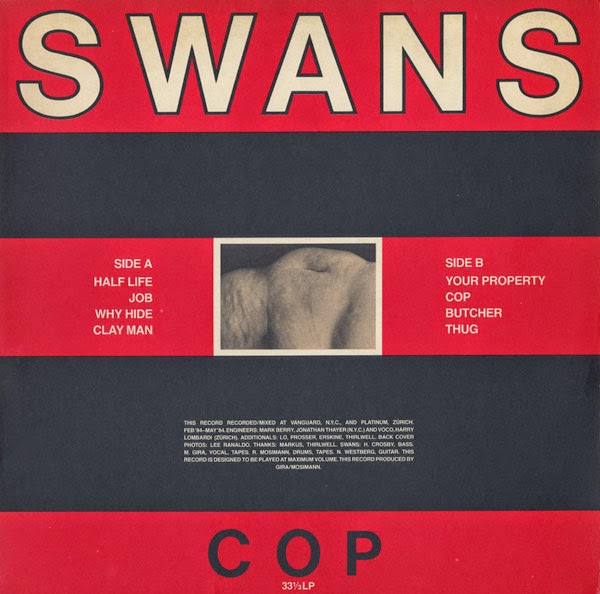
Consisting of a four-piece lineup -- Mosimann on drums, Westberg on guitar, Harry Crosby on bass, and naturally Gira on vocals -- on their second full album Swans add even more vicious crunch to their basic approach, resulting in quite possibly one of the darkest recordings ever done. Gira's words come across a little more forcefully and cleanly than before, and the existential horror shows that he details, almost always phrased in confessional/accusatory "I - you" terms, make up in sheer power what they lack in any kind of subtlety. For example, typical lyrics, from the snarling "Your Property" state: "I give you money -- you're superior. I don't exist. You control me." Matching his at-times unearthly moans and cries perfectly, the pounding music mostly consists of one slow, descending chord progression or a repetitive series of one or two notes after another, extending the power of loud feedback and amped drums to indescribably forceful effect. The opening grind alone on "Why Hide," as Westberg stretches out his strings behind Mosimann and Crosby's pummeling, is crushing enough before Gira delivers a harrowing vocal. The most legendary track from the album is the title cut; as a vicious anti-boys-in-blue rant finds its equal only in N.W.A.'s "Fuck Da Police." With such thoroughly bilious Gira lines as "Nobody rapes you like a cop in jail" providing the mental pictures, a slow, steady punch of music gets slowly but surely more aggressive and destructive as the song unfolds to its raging conclusion. Jim Thirlwell, aka Foetus, helps contribute to the apocalyptic noise on the release, but you somehow figure that Swans would have reached this state quite well on their own regardless. Ugly, compelling, and overpowering, Cop remains the pinnacle of Swans' brutal early days.

From the same sessions that produced the Cop album come these four numbers (collectively called, after the fact, the Young God EP), which understandably approach the level of total intensity in that release. Though there's not much in the way of difference from the Cop sound, a few interesting turns surface, showing that the band grew even more creative and powerful as they went. "I Crawled," the first song, has Gira initially huskily singing rather than raging or declaiming, which leads to an ominous, wordless, overdubbed choir effect; the contrast of his haunted vocals with the music (especially Mosimann's percussion, even more pinpoint-pounding and ominously echoed here) takes no prisoners, especially when everything goes completely haywire towards the end. "Raping a Slave," possibly the definitive Swans songtitle, and "This Is Mine" both contribute well, as expected, to the aura of destruction lingering over the release, but "Young God" is another main winner, with crushing drum/bass hits counterpointed by an at-times oddly gentle guitar and Gira's near-wordless wails. An excellent four-song précis of Swans at that time.

This initial reissue of the Cop album and the initially untitled 1984 EP benefits from a full remastering overseen by Gira; no new or otherwise unavailable tracks were included beyond the original contents. At the time of its release, this double album was quite important given the out-of-print status of the original releases; however, this particular pairing has since been superseded by the Cop/Young God/Greed/Holy Money release in 1999.


Swans - Cop + Young God  (flac 488mb)

Cop
01 Half Life 4:18
02 Job 4:45
03 Why Hide 5:50
04 Clay Man 5:05
05 Your Property 4:46
06 Cop 6:47
07 Butcher 4:00
08 Thug 5:10
Young God
09 I Crawled 5:39
10 Raping A Slave 6:22
11 Young God 7:03
12 This Is Mine 5:24

Swans - Cop + Young God   (ogg 171mb)

xxxxx xxxxx xxxxx xxxxx xxxxx

This re-release, from the original series of Swans reissues done in the early 1990s, is at once less and more than the title indicates, following the pattern established by the 1988 American release of the material by the Skin side project. Rather than being a straight collection of these two albums, in fact the disc also collects the A-sides from the "Time Is Money (Bastard)" and "A Screw" singles, along with the A Screw B-side "Blackmail," while subtracting the original version of "Fool" from Greed and the second version of "Money is Flesh" from Holy Money. To top it all off, the running order of all the tracks has been completely rearranged. Given that all the songs were essentially recorded at the same session and that the two albums were complementary releases, no noticeable difference in style from song to song is apparent. The sequencing works quite well in any event, and Gira's choice of songs really can't be argued with, only leaving off as he does alternate takes of album tracks rather than wholly unique songs. Still, it can be a bit distracting to the hardcore fan or collector. Those simply interested in the excellent music won't be disappointed, but this release has since been fully superseded by the Cop/Young God/Greed/Holy Money re-release from 1999.


Swans - Greed + Holy Money (flac 493mb)

01 Time Is Money (Bastard) 6:19
02 Money Is Flesh 4:57
03 Another You 7:47
04 Blackmail 4:42
05 A Screw (Holy Money) 5:04
06 Fool 5:51
07 Stupid Child 5:21
08 Anything For You 4:22
09 Nobody 4:41
10 A Screw 5:39
11 Heaven 4:54
12 Coward 5:08
13 A Hanging 5:48
14 You Need Me 1:22
15 Greed 6:13

Swans - Greed + Holy Money  (ogg 177mb)

xxxxx xxxxx xxxxx xxxxx xxxxx

Nov 4, 2014

RhoDeo 1444 Roots

Hello, ok so currently I have a windows xp pro working somewhat-no network or sound, it enables me to create ogg and zip up. Have re-upped last weeks Super Mama as there had been some complaints there..

Ok the Flacs here have been cleanly zipped by a cured PC
xxxxx xxxxx xxxxx xxxxx xxxxx


Although visitors may know Etoile De Dakar, many of the amazing 1970s-era musicians on this double album compilation (another excellent entry in the long-running African Pearls series) will be new. In this case, better late than never, as the lively, melodic tracks here reveal one gem after another.
This is amazing work from the Senegalese scene of the 70s, easily one of the hippest musical hotspots on the African continent at the time, as you'll hear by the wonderful tracks on this set! Senegalese groups really embrace a wide range of sounds not just traditional elements, or occasional influences from American blues and soul, but also a good dose of Latin and Cuban music too all wrapped together in uniquely different ways by each of the different artists in this set. There's a bit more diversity to the music here than on other regional collections, and that's what makes this one so great a truly wonderful entry in the well-named African Pearls series, supported with full notes in English and French. Titles include "Hombre Misteriosoy" by Etoile De Dakar, "Senegambia" by Star Band De Dakar, "Xarit" by Orchestra Baobab, "Guethe" by Star Band De Dakar, "Faran Tamba" by Star Number One, "Daida" by Xalam, "Rele Te Contan" by Guelawar, "Nijaay" by Orchestra Baobob, "Maaduleen" by Super Diamono De Dakar, "Boubou Ngary" by Etoile 2000, "Xal Dey Mag" by Ifang Bondi, "Xadim" by N'Guewel, and "Kery Goro" by Star Number One


Various - Super African Pearls - Sénégal 70 : Musical Effervescence 1  (flac  424mb)

01 Star Number One - Faran Tamba 4:37
02 Xalam - Daïda 7:26
03 Super Diamono De Dakar - Maaduleen 4:49
04 Orchestra Baobab - Nijaay 3:37
05 Star Band De Dakar - Guethe 4:47
06 Star Number One - Senegal Jambar 6:09
07 Guelawar - Relen Te Contan 8:30
08 Watto Siita - Jambar 4:20
09 Star Number One - Suma Dom Ji 5:25
10 Etoile De Dakar - Tolou Badou Ndiaye 6:56
11 Star Band De Dakar - Gossando 4:53
12 Orchestra Baobab - Sey 5:25
13 Etoile De Dakar - Footane 6:59

Various - Super African Pearls - Sénégal 70 : Musical Effervescence 1  (ogg  160mb)

xxxxx

Various - Super African Pearls - Sénégal 70 : Musical Effervescence 2  (flac  408mb)

01 Orchestra Baobab - Xarit 6:17
02 Star Band De Dakar - Senegambia 5:37
03 Star Number One - Mory 7:49
04 N'Guewel - Xadim 4:54
05 Orchestra Baobab - Kelen Ati 6:36
06 Ifang Bondi - Xalel Dey Mag 4:53
07 Ouza Sénégal - 80 6:26
08 Orchestra Baobab - Juana 5:06
09 Etoile De Dakar - Hombre Misterlosoy 6:45
10 Etoile 2000 - Boubou Ngary 5:24
11 Diarama De St Louis - Xaste Waroul 8:41
12 Star Number One - Kery Goro 3:56
13 Orchestra Baobab - El Carretero 5:25

Various - Super African Pearls - Sénégal 70 : Musical Effervescence 2   (ogg 142mb)

xxxxx xxxxx xxxxx xxxxx xxxxx


Recorded in Paris in 1978, On Verra Ca is the first recording by the fully matured Orchestra Baobab. The rumba influence is pronounced on the opening "El Son De Llama," but mostly the Latin tinge has now been absorbed into a distinctive group sound, with upbeat, sprightly songs like "Africa" built around choppy, syncopated riffs flavored by horns and a galloping rhythm guitar. "Sibam" follows that blueprint, but the tempo is faster and there's a stronger percussion presence than the light norm here. The title track is the masterpiece in this vein -- the vocal blend makes the endlessly repeated riff broken up by brief solos not only bearable, but so totally hypnotic it sticks in your head for days. The slow, mournful "Tante Marie" boasts two-sax horn parts and a moody guitar melody -- the opening to Barthelemy Attisso's solo opening even sounds a little bit like something from the third Velvet Underground album, of all things. "El Fuego" has more of a Latin lilt and exceptionally good voices, while the horns and those vocal harmonies again really cut through on the highly infectious "Digon." It's hard to pinpoint precisely what makes Orchestra Baobab's vocal squad sound so special -- probably a combination of the quality of the different voices and the unforced naturalness and sincerity of the singing. The highly compressed sound that prevents the music from punching hard probably keeps On Verra Ca from being a great album, but it's a highly enjoyable one and certainly put Orchestra Baobab on the road to the Bamba bomb.


Orchestra Baobab ‎– On Verra Ca  (flac  361mb)

01 El Son De Llama
02 On Verra Ca
03 Tante Marie
04 Africa
05 El Fuego
06 Sibam
07 Wane Ma Magu
08 Thioisanne
09 Mi Son
10 Digon Gama

Orchestra Baobab ‎– On Verra Ca  (ogg 146mb)

xxxxx xxxxx xxxxx xxxxx xxxxx

Nov 3, 2014

RhoDeo 1444 Blakes

Hello, a US Grand Prix got the expected results, smaller F1 teams have been sent into receivership as the big boys take more than 90% of the money, yes just like the real world, shameless bunch...

xxxxx xxxxx xxxxx xxxxx xxxxx

Ok so the coming weeks we'll have some Blake's audio drama's

In the third century of the second calendar, the galactic Federation, once a beacon of democracy and peace, has become a corrupt tyranny. Freedom and Justice are things of the past. Roj Blake stood up for the ordinary people. When the establishment tried intimidation he laughed in their faces. When they tried to crush him he fought back. When they tried to brainwash him into obedience, he broke their conditioning. Finally they framed him and sentenced him to permanent exile on the notorious prison planet Cygnus Alpha. The Federation thinks it has seen the last of Roj Blake. The Federation will wish it had... And now Roj Blake is on the run... He has a ship, but the ship has plans of its own. He has a crew, but who are his friends and who are his enemies? Blake thought space meant freedom, but space is cold, cruel and steeped in blood. The power of the federation reaches further and deeper then Blake dared imagine... Freedom is nowhere to be found.

B7 Productions produced series of 30-minute prequel audio episodes, which explored the earlier histories of the central characters. These were broadcast on BBC Radio 4 Extra from 2010.

Earth. 2230 AD. A time of social and political turmoil… Olag Gan wants to marry the woman of his dreams. Vila Restal wants to steal anything that isn’t nailed down. When they form a partnership, a perfect combination of strength and skill, it seems that nothing stands between them and the easy life. But fate hates to give a sucker an even break and the course of true love never did run smooth.


xxxxx xxxxx xxxxx xxxxx xxxxx

Blake's 7 - When Vila Met Gan (mp3 25mb)

E01 - When Vila Met Gan 26:33

Michael Keating as Vila, Owen Aaronovitch as Gan and Alistair Lock as Zen

xxxxx xxxxx xxxxx xxxxx xxxxx

previously

Blake's 7 - The SevenFold Crown (mp3 83mb)
Blake's 7 - The Syndeton Experiment (mp3 52mb)
Blake's 7 - Rebel (mp3 53mb)
Blake's 7 - Traitor (mp3 53mb)
Blake's 7 - Liberator (mp3 54mb)

xxxxx xxxxx xxxxx xxxxx xxxxx

Nov 1, 2014

RhoDeo 1443 Grooves

Hello, as human spacetravel proved to be not without danger this week with no less than 2 accidents, one of the virgin testpilots already lost his life another severely injured. It brings home to all those that enthusiastically payed up for a Virgin galactic spacetrip that there's real risk. Meanwhile there is some trick and treat warm weather in the air, unfortunately next week we'll be back to normal as we'll lose 10C no longer basking in the sun.....

Today, one of the most influential soul singers of the 1960s, he exemplified to many listeners the power of Southern "deep soul" -- hoarse, gritty vocals, brassy arrangements, and an emotional way with both party tunes and aching ballads. He was also the most consistent exponent of the Stax sound, cutting his records at the Memphis label/studios that did much to update R&B into modern soul. His death at the age of 26 was tragic not just because he seemed on the verge of breaking through to a wide pop audience, but it was also unfortunate because, as "Dock of the Bay" demonstrated, he was also at a point of artistic breakthrough in terms of the expression and sophistication of his songwriting and singing.   ......N'joy

xxxxx xxxxx xxxxx xxxxx xxxxx

Otis Ray Redding, Jr. (September 9, 1941 – December 10, 1967) was an American singer-songwriter, record producer, arranger and talent scout. He is considered one of the greatest singers in the history of American popular music and a seminal artist in soul and rhythm and blues. His singing style was powerfully influential among soul artists of 1960s and helped exemplify the Stax sound.

Born and raised in Georgia, United States,  from age 10, he took drum and singing lessons. At Ballard-Hudson High School, he sang in the school band. Every Sunday he earned $6 by performing gospel songs for Macon radio station WIBB. Redding left school at age 15 to support his family, working with Little Richard's backing band, the Upsetters, and performing at talent shows for prize money. In 1958, he joined Johnny Jenkins's band, the Pinetoppers, and toured the Southern United States as a driver and musician. At age 19, Redding met 15-year-old Zelma Atwood at "The Teenage Party." She gave birth to their son Dexter in the summer of 1960 and married Redding in August of 1961. In mid-1960, Otis moved to Los Angeles with his sister, Deborah, where he wrote his first songs including "She's Allright," "Tuff Enuff," "Gamma Lamma," and the song "Gettin' Hip," Redding's first composition released as a 45 RPM single recording. An unscheduled appearance on a Stax recording session led to a contract and his first single, "These Arms of Mine", with "Hey Hey Baby" on the B-side. The single was released on Volt on October 1962, but charted in March the following year. It became one of his most successful songs, selling more than 800,000 copies. Stax released Redding's debut album Pain in My Heart two years later.

Redding's success allowed him to buy a 300-acre (1.2 km2) ranch in Georgia, which he called the "Big O Ranch."[33] Stax was also doing well. Walden signed more musicians, including Percy Sledge, Johnnie Taylor, Clarence Carter and Eddie Floyd, and together with Redding they founded two production companies.

In late 1966, Redding returned to the Stax studio. At this session he recorded tracks including "Try a Little Tenderness", originally written by Jimmy Campbell, Reg Connelly and Harry M. Woods in 1932. This song had previously been covered by Bing Crosby and Frank Sinatra, and the publishers unsuccessfully tried to stop Redding from recording the song from a "negro perspective'. Today often considered his signature song, his performance is so special and so unique that it expresses who he is." On this version Redding was backed by Booker T. & the M.G.'s, while staff producer Isaac Hayes worked on the arrangement.

Initially popular mainly with African Americans, Redding later reached a wider American popular music audience. Along with his group, he first played small gigs in the American South, then debuted in the western United States at L.A.'s popular night club the Whisky a Go Go. Later appearances included Paris, London and other European cities.

A year after the Fillmore, Redding released the gold record-winning album King & Queen, with Carla Thomas. It was Jim Stewart's idea to produce a duet album, as he expected that "[Redding's] rawness and [Thomas'] sophistication would work". The album was recorded in January 1967, while Thomas was earning her M.A. in English at Howard University. Six out of ten songs were cut during their joint session; the rest were overdubbed by Redding in the days following, due to concert obligations. Three singles were lifted from the album: "Tramp" was released in April, followed by "Knock on Wood" and "Lovey Dovey". All three reached at least the top 60 on both the R&B and Pop charts. The album charted at number 5 and 36 on the Billboard Pop and R&B charts, respectively.

In 1967, Redding performed at the influential Monterey Pop Festival as the closing act on Saturday night, the second day of the festival. Until that point, Redding was still performing mainly for black audiences. Redding and his backing band (Booker T. & the M.G.'s with the Mar-Keys horn section) had opened with Cooke's "Shake" His act, which included his own song "Respect" and a version of the Rolling Stones' "Satisfaction", was well received by the audience.

After Monterey, Redding wanted to record with Conley, but Stax was against the idea. The two moved from Memphis to Macon to continue writing. The result was "Sweet Soul Music", based on Cooke's "Yeah Man". It peaked at number 2 on the Billboard Hot 100. By that time Redding had developed polyps on his larynx, which he tried to treat with tea and lemon or honey. He was hospitalized in September 1967 at Mt. Sinai Hospital in New York to undergo surgery.

In early December 1967, Redding again recorded at Stax. One new song was "(Sittin' On) The Dock of the Bay", which was written with Cropper while they were staying with their friend, Earl "Speedo" Sims, on a houseboat in Sausalito. Redding was inspired by the Beatles album Sgt. Pepper's Lonely Hearts Club Band and tried to create a similar sound against the label's wishes. His wife Zelma disliked its atypical melody. The Stax crew were also dissatisfied with the new sound; Stewart thought that it was not R&B, while bassist Donald "Duck" Dunn feared it would damage Stax's reputation. However, Redding wanted to expand his musical style and thought it was his best song and correctly believed it would top the charts. Redding whistled at the end, either forgetting Cropper's "fadeout rap", or paraphrasing it intentionally.

By 1967 the band was traveling to gigs on Redding's Beechcraft H18. On December 9, 1967, they appeared on the Upbeat television show produced in Cleveland. They played three concerts in two nights at a small club called Leo's Casino. After a phone call with Zelma and their children, Redding's next stop was Madison, Wisconsin; the next day they were to play at the Factory nightclub near the University of Wisconsin.

Although the weather was poor, with heavy rain and fog and despite warnings, the plane took off. Four miles from their destination at Truax Field in Madison, the pilot radioed for permission to land. Shortly thereafter, the plane crashed into Lake Monona. The cause of the crash was never determined.

"(Sittin' On) The Dock of the Bay" was released in January 1968 and became Redding's only single to reach number one on the Billboard Hot 100, and the first posthumous number-one single in US chart history. It sold approximately four million copies worldwide and received more than eight million airplays. The album The Dock of the Bay was the first posthumous album to reach the top spot on the UK Albums Chart.

Shortly after Redding's death, Atlantic Records, distributor of the Stax/Volt releases, was purchased by Warner Bros. Stax was required to renegotiate its distribution deal and was surprised to learn that Atlantic actually owned the entire Stax/Volt catalog. Stax was unable to regain the rights to its recordings and severed its Atlantic relationship. Atlantic also held the rights to all unreleased Otis Redding masters. It had enough material for three studio albums—The Immortal Otis Redding (1968), Love Man (1969), and Tell the Truth (1970)—all issued on its Atco Records. A number of successful singles emerged from these LPs, among them "Amen" (1968), "Hard to Handle" (1968), "I've Got Dreams to Remember" (1968), "Love Man" (1969), and "Look at That Girl" (1969).

Redding received many posthumous accolades, including the Grammy Lifetime Achievement Award and induction into the Rock and Roll Hall of Fame and the Songwriters Hall of Fame. He received the honorific nickname King of Soul. In addition to "(Sittin' On) The Dock of the Bay," "Respect" and "Try a Little Tenderness" are among his best-known songs.

Five of his albums, Otis Blue: Otis Redding Sings Soul, Dreams to Remember: The Otis Redding Anthology, The Dock of the Bay, Complete & Unbelievable: The Otis Redding Dictionary of Soul and Live in Europe, were ranked by Rolling Stone on their list of the "500 Greatest Albums of All Time".


xxxxx xxxxx xxxxx xxxxx xxxxx

Pain in My Heart includes songs from Redding's 1962–1963 sessions. Stewart signed Redding for Stax and released Redding's debut single "These Arms of Mine", with "Hey Hey Baby" on the B-side. "These Arms of Mine", released on the Volt sister label on October 1962, but charted in March the following year, became one of his most successful songs, selling more than 800,000 copies.

In the 1963 session, "That's What My Heart Needs" and "Mary's Little Lamb" were recorded and cut in June 1963; the latter became one of the worst-selling singles by Redding.[9][11] According to Soulsville U.S.A.: The Story of Stax Records author Rob Bowman, in these two songs "Otis sings with a harsh, impassioned gospel voice", and saw similarities with the voice of Blind Boy Archie Brownlee, and further reckoned the ending of the first would have made Redding "a suberp gospel singer had he chosen to record in that idiom." "That's What My Heart Needs" became Redding's second single on Stax.

Pain in My Heart set the pattern for all his ballads to come—Otis triumphed at rendering agony. Signs of the singer's virtuosity are already apparent in the almost teasing way he lingers over some lyrics and spits out others; virtually never would he sing a line the same way twice.

Sings Soul Ballads was one of the first issued by Volt Records, a sub-label of Stax Records, and Redding's first on the new label. Like Redding's debut Pain in My Heart, Soul Ballads features both soul classics and originals written by Redding and other Stax Records recording artists. The recording sessions took place at the Stax studios in Memphis. The album features a stereo mixer made by engineer Tom Dowd, replacing the early mono mixer.

The album features the Booker T. & the M.G.'s, the horn section Memphis Horns and the pianist Isaac Hayes, who possibly first appeared on this album, although this is disputed, as he was not credited on the liner notes. Unlike Redding's debut album, Sings Soul Ballads was released both on Atlantic's subsidiary Atco Records and Stax's Volt Records. While the album and its singles were moderately successful on the music charts, it includes Redding's first top-ten single, "Mr. Pitiful".


Otis Redding - Pain In My Heart/Sings Soul Ballads (flac 122mb/128mb=275mb)

01 Pain in My Heart 02:24
02 The Dog 02:36
03 Stand by Me 02:52
04 Hey Hey Baby 02:47
05 You Send Me 03:15
06 I Need Your Lovin' 02:53
07 These Arms of Mine 02:34
08 Louie, Louie 02:07
09 Something Is Worrying Me 02:29
10 Security 02:37
11 That's What My Heart Needs 02:41
12 Lucille 02:28

Sings Soul Ballads

01 That's How Strong My Love Is 02:26
02 Chained And Bound 02:42
03 A Woman, A Lover, A Friend 03:21
04 Your One And Only Man 03:14
05 Nothing Can Change This Love 03:04
06 It's Too Late 03:03
07 For Your Precious Love 02:57
08 I Want To Thank You 02:40
09 Come To Me 02:50
10 Home In Your Heart 02:06
11 Keep Your Arms Around Me 02:53
12 Mr. Pitiful 02:40

xxxxx xxxxx xxxxx xxxxx xxxxx

Otis Blue, released September 15, 1965 on Stax Records, is the third studio album by soul singer Otis Redding. The album mainly consists of cover songs by popular R&B and soul artists, and, bar one track, was recorded in a 24-hour period over July 9/10 1965 at the Stax Recording Studios in Memphis, Tennessee. Otis Blue was critically acclaimed upon release and became one of Redding's most successful albums; it reached number 6 on the UK Albums Chart, and was his first to reach the top spot of the Billboard R&B chart. Otis Blue is included in Rolling Stone's 500 Greatest Albums of All Time, and Robert Dimery's "1001 Albums You Must Hear Before You Die".

The Soul Album shows him moving from strength to strength in a string of high-energy, sweaty soul performances, interspersing his own songs with work by Sam Cooke ("Chain Gang"), Roy Head ("Treat Her Right"), Eddie Floyd ("Everybody Makes A Mistake"), and Smokey Robinson ("It's Growing") and recasting them in his own style, so that they're not "covers" so much as reinterpretations; indeed, "Chain Gang" is almost a rewrite of the original, though one suspects not one that Cooke would have disapproved of. He still had a little way to go as a songwriter -- the jewel of this undervalued collection is "Cigarettes And Coffee, co-authored by Eddie Thomas and Jerry Butler -- but as an interpreter he was now without peer, and his albums were now showing this remarkable, stunningly high level of consistency.


Otis Redding - Otis Blue/The Soul Album (flac 132mb/125mb = 285mb)

01 Ole Man Trouble 02:39
02 Respect 02:08
03 A Change Is Gonna Come 04:16
04 Down In The Valley 03:01
05 I've Been Loving You Too Long 02:57
06 Shake 02:41
07 My Girl 02:58
08 Wonderful World 03:14
09 Rock Me Baby 03:25
10 Satisfaction 02:48
11 You Don't Miss Your Water 02:49

The Soul Album

01 Just One More Day 03:31
02 It's Growing 02:47
03 Cigarettes And Coffee 03:53
04 Chain Gang 03:04
05 Nobody Knows You [When You're Down And Out]03:11
06 Good To Me 03:51
07 Scratch My Back 02:42
08 Treat Her Right 02:11
09 Everybody Makes A Mistake 03:23
10 Any Ole Way 02:34
11 634-5789 [Soulville, U.S.A.] 02:49


xxxxx xxxxx xxxxx xxxxx xxxxx

Live in Europe is was Redding's first live album as well as the only live album released during his lifetime, issued exactly five months before his death on December 10, 1967. The album was recorded during the Stax/Volt tour
of Europe and Redding is backed by Booker T. & the MG's. Recorded at
the Olympia Theatre, Paris; March 21, 1967. In 2003, the album was ranked number 474 on Rolling Stone magazine's list of the 500 greatest albums of all time.


Otis Redding - Live In Europe 1967 (flac 244mb)

01 Respect 03:43
02 Can't Turn You Loose 03:28
03 I've Been Loving You Too Long 04:07
04 My Girl 02:42
05 Shake 02:56
06 Satisfaction 03:00
07 Fa-Fa-Fa-Fa-Fa (Sad Song) 04:04
08 These Arms Of Mine 03:47
09 Day Tripper 03:05
10 Try A Little Tenderness 05:07

xxxxx  (ogg 000mb)

xxxxx xxxxx xxxxx xxxxx xxxxx